
Intersections: Meditations on Southeast Asia
Reeling in history through artistic gesture 5: Kitazawa Jun
By Kanai Miki
- SHARE


All photos: Aditya Putra Nurfaizi, courtesy of the artist
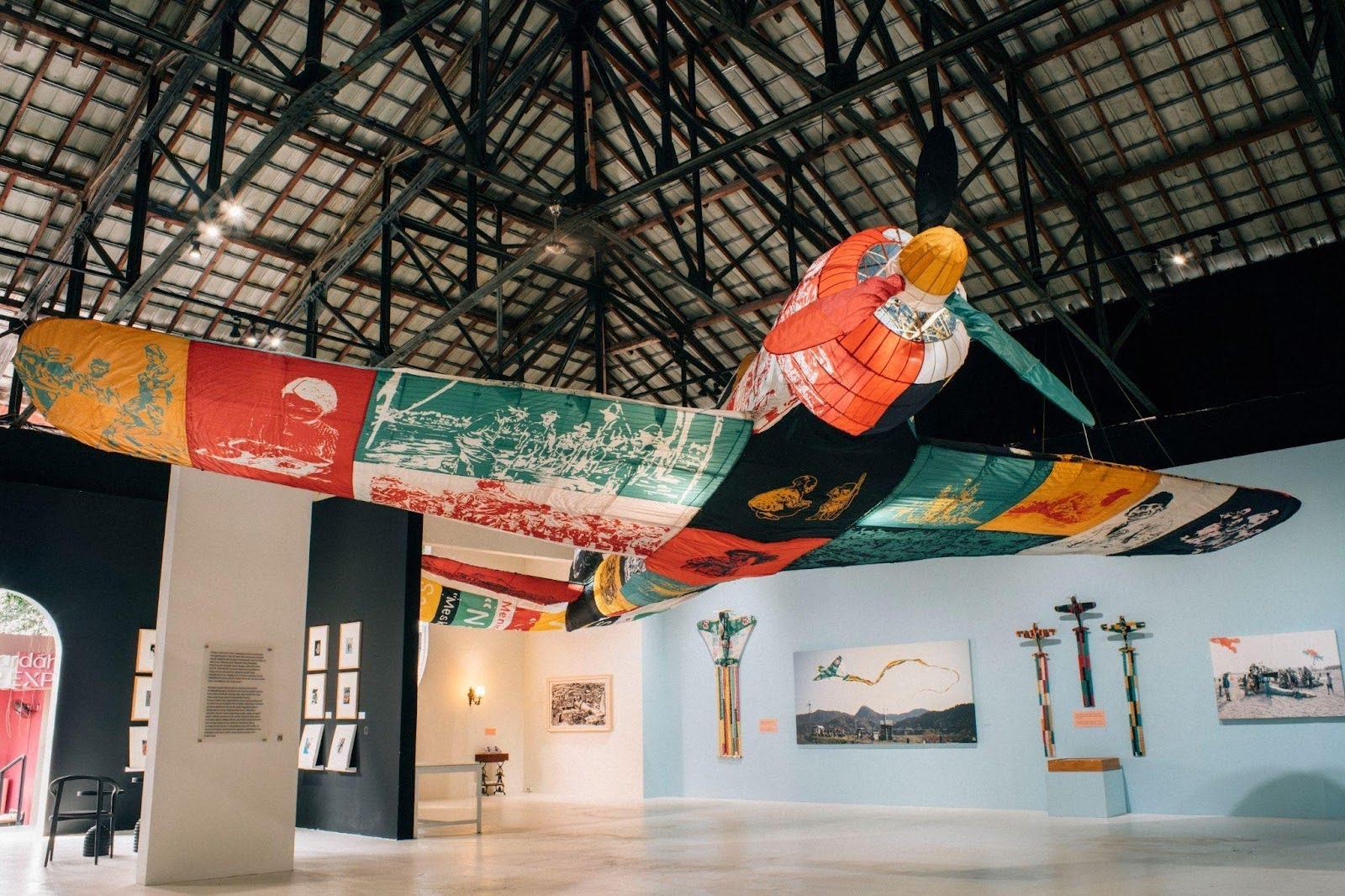
Wings spread wide in the cavernous hall, a full-size fighter plane sat suspended in mid-air as if sweeping in close to the ground. Accompanied by the motion of a slowly rotating propeller, the aircraft exuded a staggering presence, parting the very space. In this setting with its exposed ceiling framework, even the air-conditioning fans began to resemble propellers, adding to the sensation of having wandered into a hangar. But this immersive feeling does not last for long: the weight of historical memory forces its way in, returning the viewer to reality. How is history told here, and from whose point of view? What is my stand on it all? This was the 2024 edition of ARTJOG1, the annual contemporary art festival held in the Indonesian city of Yogyakarta in central Java. Rounding off the exhibition was the Hayabusa aircraft from Kitazawa Jun’s Fragile Gift project2.
The Hayabusa was a fighter deployed by the Japanese Imperial Army in occupied regions of Southeast Asia during World War II. When the Dutch tried to regain control of their colonies following the surrender of Japan in August 1945, the Indonesians in turn deployed the planes to fight back in the ensuing war of independence. As the aircraft looms into view here as a work of art, it brings with it memories of war, vestiges of colonialism, and the historical reality of the battle for independence. Do the locals see this plane as a painful symbol of Japanese military might, or as a Hayabusa reinterpreted in the context of the fight for independence?
The aircraft colors of vibrant red, green and orange make an odd accompaniment to the weighty themes of war and colonial rule. No way is this merely decorative: surely it must be a means to command the spectator’s attention and generate resonance between past memories, and present-day sensations. What emerges visually is a manifestation of multiple layers of memory in the form of historical fragments and events, entwined. The fact that this warplane cloaked in memories is a giant 11 x 8 meter, fully-functional kite, comes as a surprise.
Assembled from bamboo, rattan and fabric on the premise that it will be soaring through the air, the work owes its existence to highly skilled attention to detail, and a creative approach. Though reflecting traditional artisanal skills and cultural customs, kite-making in Indonesia is distinguished by the fusion of these traditions with modern ideas. But this Hayabusa kite could still be described as an oddity. Created with the help of local kite-makers via exhaustive trial and error, the plane does actually fly. Its ascent does not merely realize its form, but embodies the significance of a process in which the history borne by the work is re-read, released, and reborn. Yet while the kite format nullifies the violence of Hayabusa’s status as a fighter plane, it also risks turning historical fact into celebration. Amid such ambiguity, what questions does the work pose of the viewer?
vThe gallery walls display documentary footage of the production work undertaken for this project, the Hayabusa kite actually being flown on the beach, and of interviews in which local residents talk about the colonial era; plus drawings, photographs, and models on the theme of the Hayabusa aircraft. A photo of the Hayabusa kite after crash landing on a test flight at the beach overlaps with a depiction from historical records of people standing around a real Hayabusa aircraft. By superimposing a momentary incident on the beach, and historical scene from the past, Kitazawa causes viewers to experience the intersection of different timelines, and makes them conscious of the continuing connection between history and the present day.
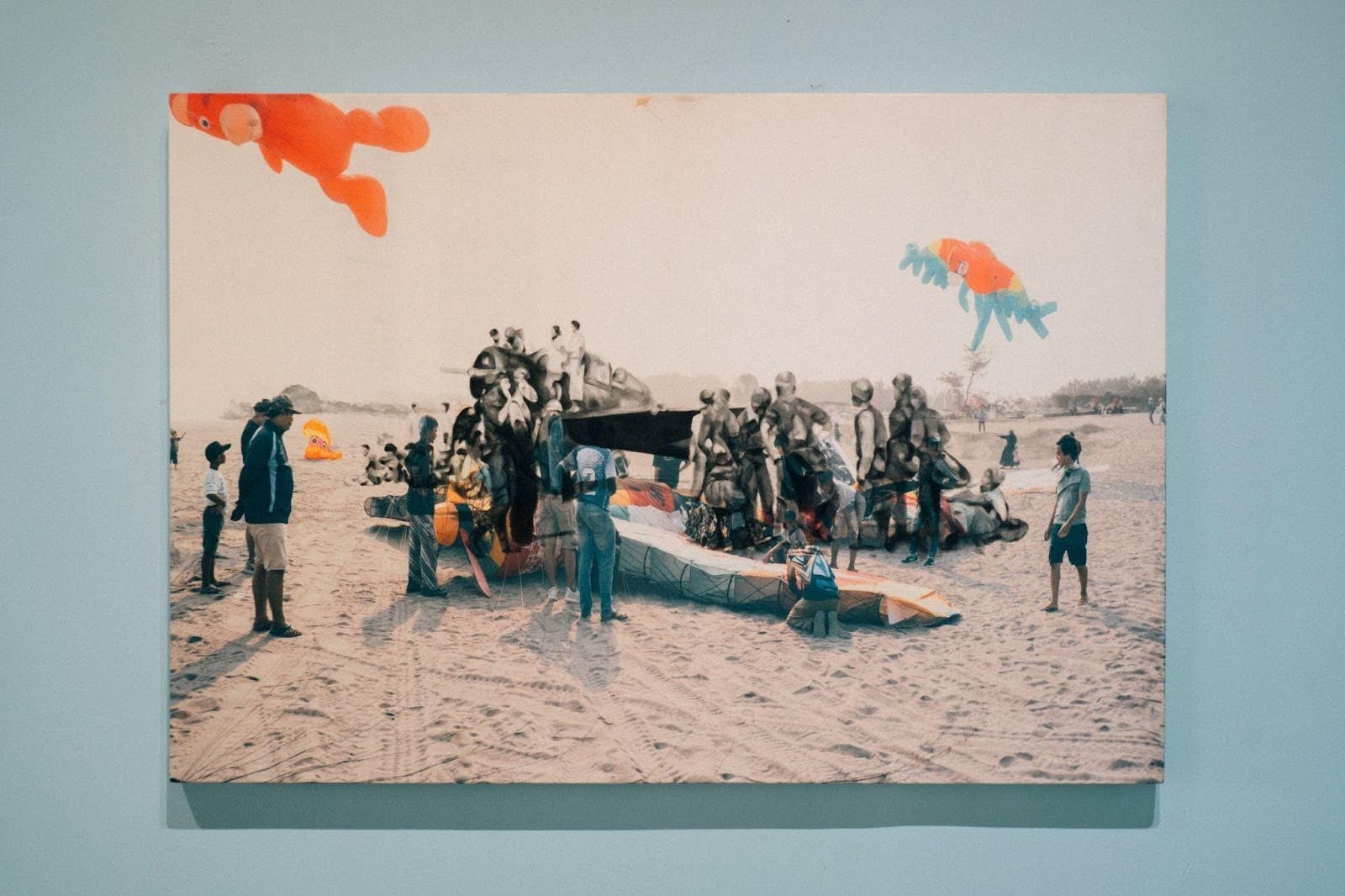
Fragile Gift: A Dual Memory, 2024
The work’s complex structure encourages the viewer to think deeply. At the exhibition, local visitors stood beneath the plane, gazing eagerly upward and discussing the work. As an observer from a different linguistic and cultural background, I could only guess at the emotions and interpretations forming the basis of their responses. In addition, a banner extended from the tail of the aircraft, all the way to outside the venue. There was something written on it, in Indonesian I surmised, but exactly what, I did not understand at that point. Even so, it was easy to sense how the exhibition was deliberately structured to ask local visitors incisive questions, and traversed multiple interpretive frameworks.
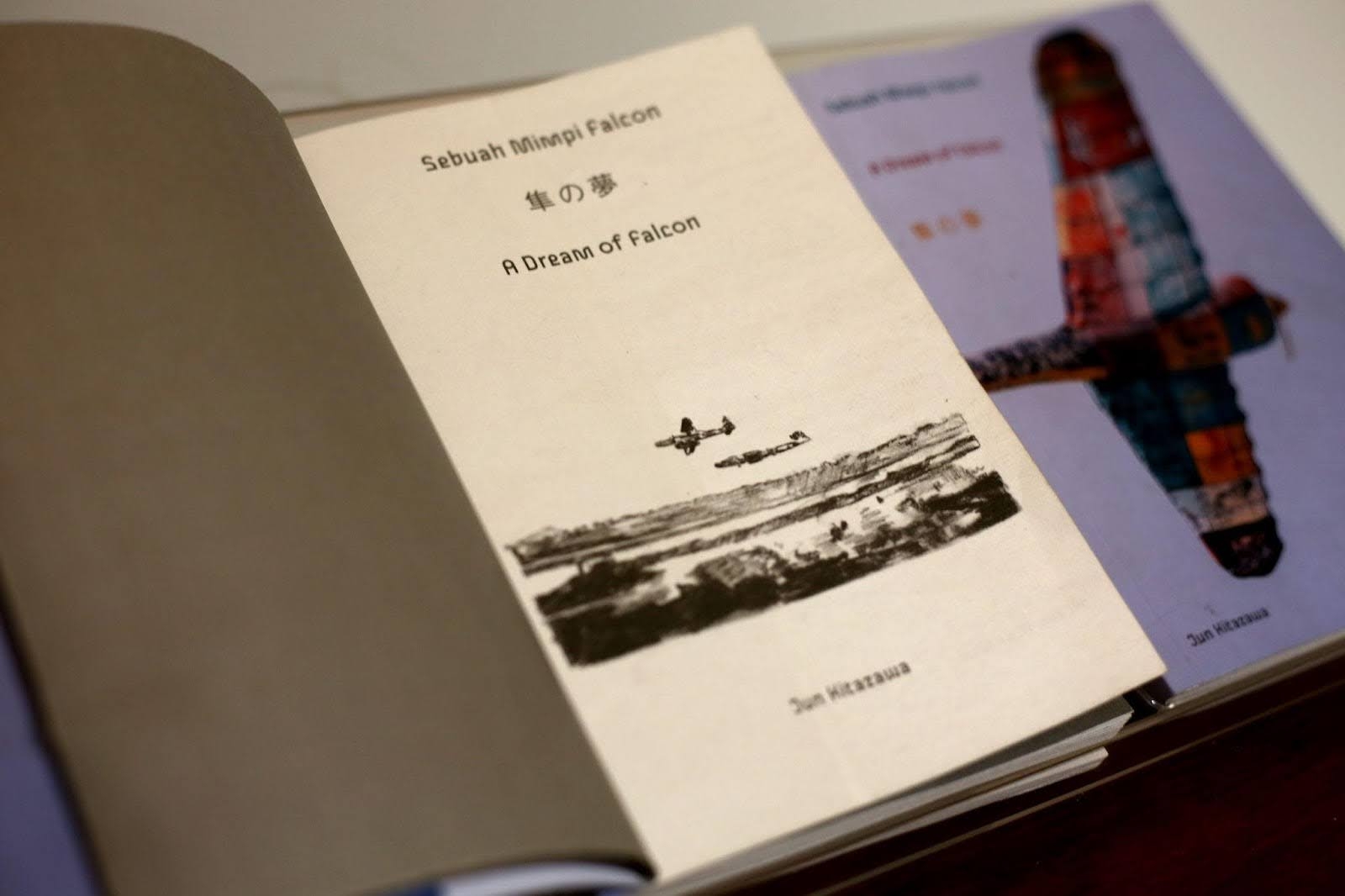
The night before heading there I had joined two other Japanese artists to visit Kitazawa Jun’s studio in Yogyakarta. The only things I knew about Kitazawa were that he was an artist taking part in ARTJOG, based in the city with a home and family there, and had a large studio. I expected some grey-bearded master artist type, but the Kitazawa who emerged to greet us was still a young man. The studio even had a small food stand set up inside, where we partook of local snacks as we chatted awhile. I was then fortunate to receive one of the few remaining copies of A Dream of Falcon, the artist’s work in book-adjacent format.
北澤潤『隼の夢』より
Courtesy of the artist
Photo by Aditya Putra Nurfaizi
During my time in Yogyakarta I met many people, and spent the days visiting exhibitions and studios. A hectic schedule left no time to sit down and pick up A Dream of Falcon, and though it was also available in a corner of the exhibition for reference, I was unable to finish the book there. I only started to properly read it after returning to Malaysia. As I turned each page, the writing there connected the images and elements of the massive kite that had commanded my attention in the hall, the background and context that had eluded me there began to take shape, and I sensed a whole new dimension being added to my understanding of the exhibition experience.
The book takes the form of a first-person account by an anthropomorphized Hayabusa aircraft (a Hayabusa Nakajima Ki-43-II). Though the text could obviously have done with more editing, this is more than compensated for by the power of the storytelling, and the charm of the idiosyncratic writing style. The story begins with an encounter between the Hayabusa still preserved/displayed in the Central Museum of the Indonesian Air Force3, and a character known as “Kitazawa.” By portraying the pair as kindred spirits—natives of Japan now in Indonesia—the intersection of personal experience and historical backdrop, and temporal and physical settings transcending national borders, are shown from the start. The gaze of the narrator “Hayabusa” does not only record events; it compels the reader to re-examine the relationship between history and the narrator’s own existence.
The images printed on the aircraft that appears in this tale are based on records of Japanese colonial rule in Indonesia collected by Kitazawa Jun in the course of extensive research. References included the Japanese army propaganda magazine Djawa Baroe (New Java) published for three years during the occupation, and material from the digital archives of Dutch museums. The images depicted on the plane range from a POW camp and Japanese officer’s residence, to local children imitating a salute, and the writing on the long piece of fabric extending from the tail turned out to be the anguished cries, and songs, of local people who raised their voices in defiance of Japanese rule. The book also highlights how Fragile Gift is not designed to be understood simply as an exhibit, but in the context of its intimate connection to the endeavors of the people involved in its making.
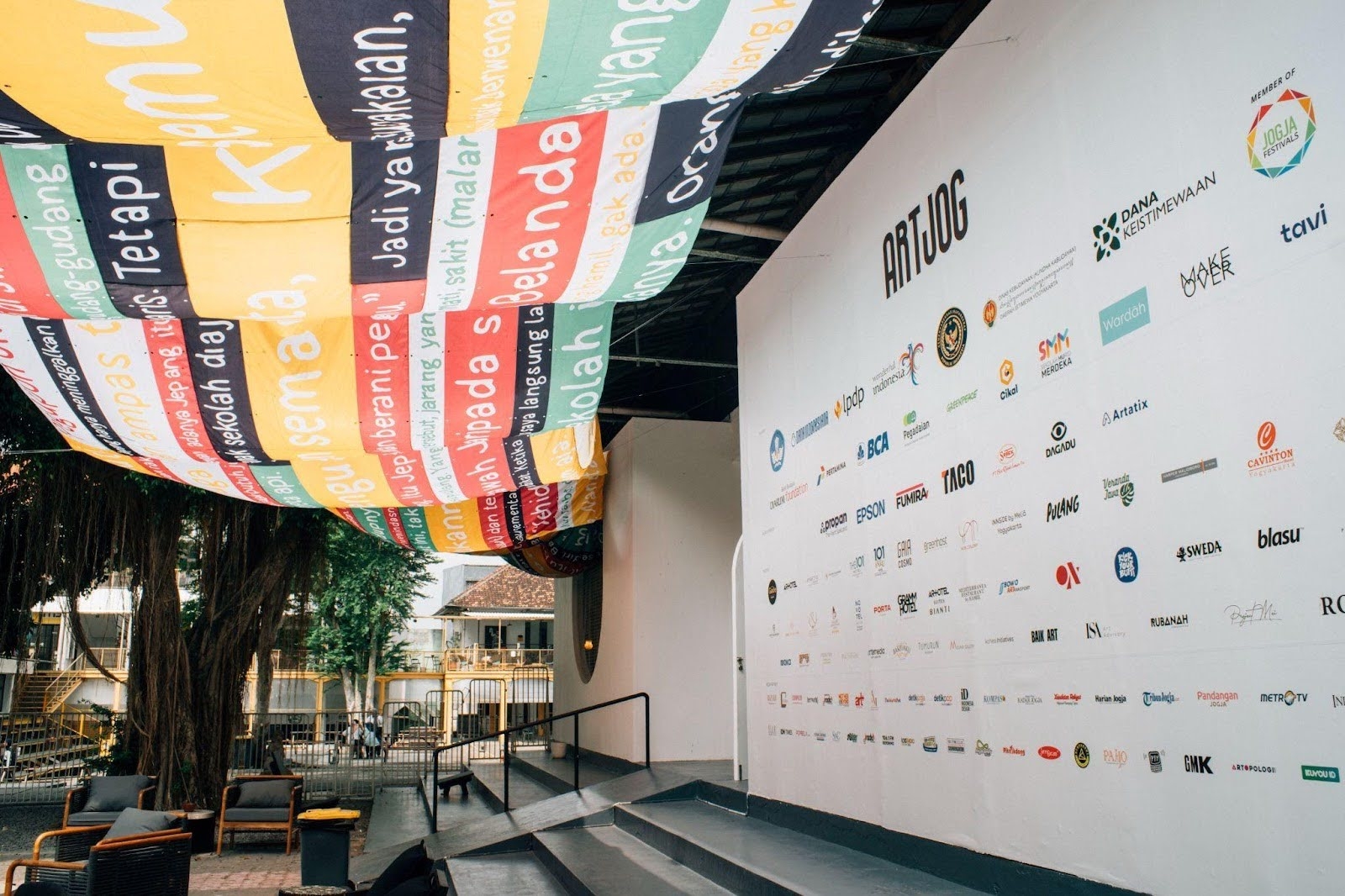
Fragile Gift, installation view.
A large number of local kite-makers were involved in the construction of this Hayabusa, pouring a great deal of labor and enthusiasm into the project while continuing to do the everyday jobs that form their livelihood. Witnessing their work on the project, it was obvious that in this trade, the transmission of cultural and technical expertise down generations is still very much alive. Through his collaboration with these artisans, Kitazawa Jun encounters a human spirit enduring beyond the colonial period, suggests the possibility of “encounters” beyond the relationship of controlling and controlled, and meditates on the meaning of meeting “as equals,” in the process illuminating the tricky issue of how to represent and understand the asymmetry of controlling and controlled in history, including that of the colonial era.
The realities of collaborations such as these are also closely linked to the ethical challenges for Japanese artists when dealing with this history—that is, whether the “collaboration” is truly one of equals, or risks taking the form of cultural exploitation. In Kitazawa’s project, final say lies with the individual, the craftsmen functioning as providers of technical skill, so the asymmetrical balance of power probably remains. Yet if for example the agent of production had been an “artist collective” made up of Kitazawa and craftsmen, and a framework put in place for sharing production principles, interpretations of history etc, the asymmetry would have been somewhat alleviated, and the representation of history and culture structured in a manner more pluralistic and equitable. Viewers would then recognize such possibilities as bringing new perspectives to the work, and reflecting different voices.
Taking such issues into account, it is possible to identify another noteworthy concept in Fragile Gift: Kitazawa’s targeting of not only exhibition visitors, but those who happen to encounter the kite outdoors. Prompted by the question of what exactly it is they are looking at, anyone who comes upon the strange sight of the Hayabusa being carried on the ground, and every now and again floating in the air, is made to ponder the relationship between history, culture, control and resistance. The images printed on the kite fabric and lines of text on the tail guide such viewers to the timeline of history, and actively stand them between the production site, and historical context. In numerous projects to date, Kitazawa has created places open to participants and local residents in living spaces firmly rooted in cities and regions in Japan, and elsewhere. In this regard Fragile Gift is a vivid demonstration of that same creative technique.
Chapter 2 of A Dream of Falcon describes a project in Taiwan. Here also, testament gathered through interviews with nine residents around the age of 90 is recorded on a length of fabric extending from the tail of a new, slightly smaller “Hayabusa.” These are not words from some prominent history book. That the memories and real voices of people living today, in the same world, are reflected directly in the work, is highly significant. I shall not go into great detail here concerning the Taiwanese example, but simply note that this narrative leads to another time and place, encouraging the viewer to think and imagine. And for that “Hayabusa,” preparations are taking shape for the day it finally takes to Japanese skies.
Inspired by the project and seized by the urge to make a pilgrimage of sorts, on my next visit to Yogyakarta, with Kitazawa’s book in hand I headed for the Central Museum of the Indonesian Air Force. There on display was a surprisingly diverse array of fighter planes, all stunning in form, but I also sensed a need to not show too much excitement around these aircraft. The experience of coming face to face with an actual Hayabusa was beyond my subjective understanding, and I was confronted by the inevitability, and the sheer chance, of being here. Both the museum and its grounds are vast, and lone female visitors seemingly a rare sight; on several occasions staff expressed concern that I had become separated from a companion.
How could the circumstances that brought me to this location be explained? I turned my thoughts once again to Kitazawa Jun’s Fragile Gift project. This work does more than occupy an exhibition space. The Hayabusa kite is a living intermediary, simultaneously fragile and robust, a poser of timeless questions. Kitazawa’s act of confronting, as a Japanese national, memories of a past war, and collaborating with local kite-makers in Indonesia to craft the work, has great significance as a different type of social/cultural intervention. Its inherent issues around asymmetry and power relationships meanwhile, merit ongoing meditation. Nevertheless, the value of the project remains solid in what it sets out to do.
The images printed on the aircraft are records, reflections, maybe even prayers. The sweat and smiles emerging during the hands-on act of production are a means to confront the pain of the past, and also a gift for the future. If only Hayabusa could be neither warplane nor kite, but a vehicle for questioning and simultaneously embracing questions, cutting through the wind and soaring across the sky, boldly connecting past and future. I cannot help but quietly conjure up this possibility, because as a Japanese national who has placed herself in Southeast Asia, and thinks about history, I am both “Hayabusa” and “Kitazawa.”
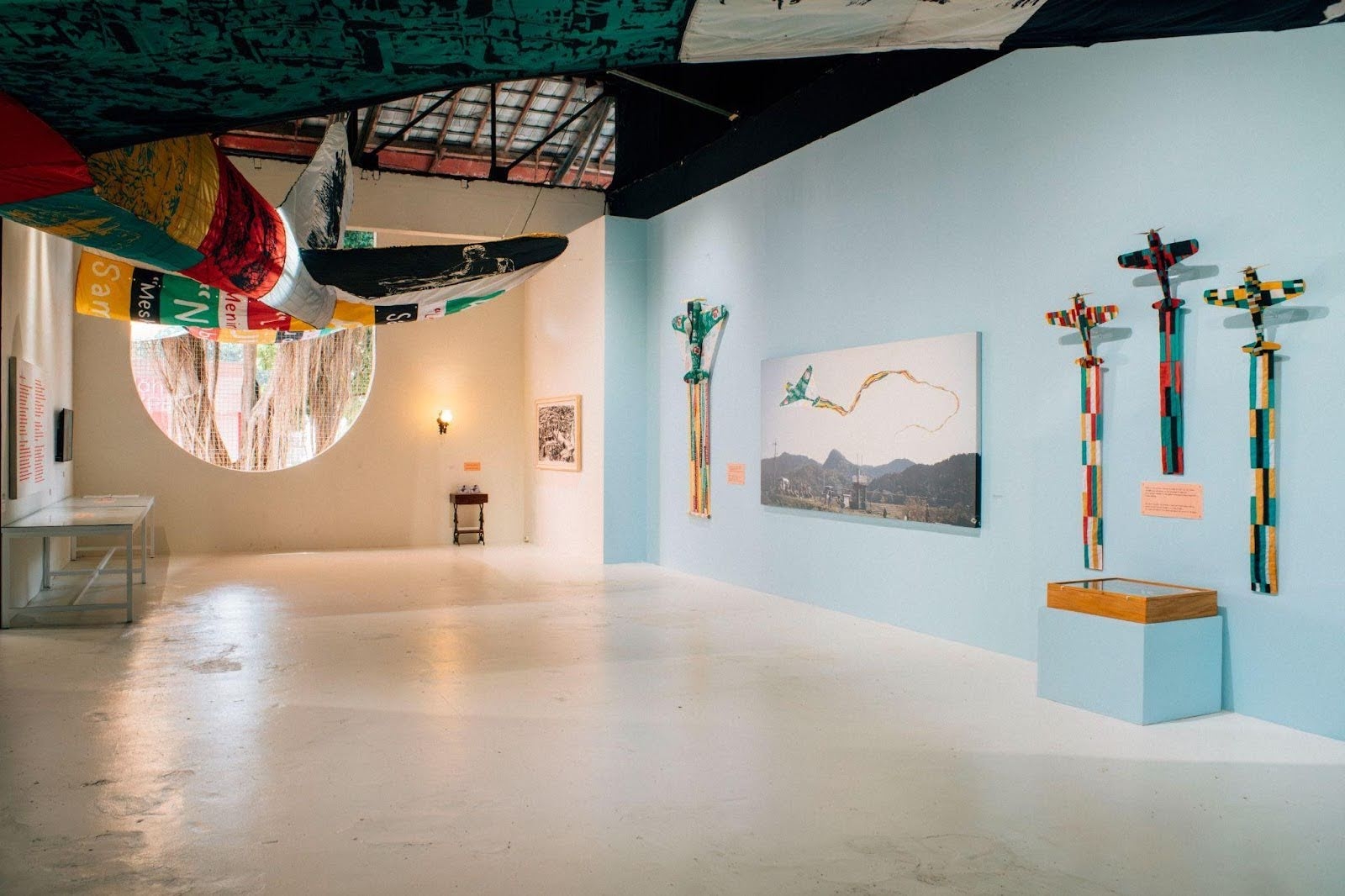
Fragile Gift, installation view.
1. ARTJOG
2. Kitazawa Jun
3. The Central Museum of the Indonesian Air Force((Museum Pusat TNI AU Dirgantara Mandala)
(All accessed April 5, 2026)About the series
“Intersections: Meditations on Southeast Asia” is a series by Malaysia-based arts and culture researcher Kanai Miki, in which she unpacks the art of Southeast Asia from multiple perspectives, including those of history, regional characteristics, and solidarity among peoples, contemplating the relationship between Southeast Asia today and art, including from a Japanese perspective.
Kanai Miki
A researcher of arts and culture, Kanai documents and analyzes artistic and cultural phenomena first hand as a journalist, and links this practical knowhow to her studies. Following an MA in 20th-century art history at Goldsmiths College, University of London, she spent around two decades based in Berlin, covering the art scene closely in over 20 European countries. Two years of this period were spent as a Japanese Agency for Cultural Affairs Program of Overseas Study for Upcoming Artists grantee (art criticism). Kanai has written for a number of Japanese art magazines including Bijutsu Techo, Geijutsu Shincho and ART iT, and also for cultural magazines such as Seikatsu Kosatsu and Studio Voice. She has introduced the European art scene and European artists to Japan through the writing and editing of books, websites, and exhibition catalogues, and as an exhibition coordinator. Currently based in Malaysia, in addition to research and writing she also helps to organize exhibitions and workshops. Member of the German branch of the International Association of Art Critics (AICA).