Out of Kyoto
005 The Question of Where to Draw the Line
By Ozaki Tetsuya
- SHARE


There has been loud debate around the 61st Venice Biennale ahead of its opening on May 9, due to the announcement by Russia that it would be returning to the Biennale following two consecutive absences since the invasion of Ukraine, and the decision by the Venice Biennale Foundation to permit the Russians to return.
On March 10, culture and foreign affairs ministers from 22 European nations urged the Biennale to reconsider,1 with the European Commission (EC) also issuing a statement strongly condemning the Foundation’s decision that concludes, “This decision by the Fondazione Biennale is not compatible with the EU’s collective response to Russia’s brutal aggression. Should the Fondazione Biennale go forward with its decision to allow Russia’s participation, we will examine further action, including the suspension or termination of an ongoing EU grant to the Biennale Foundation.”2 Said grant amounts to two million euros. Even the government of Italian Prime Minister Giorgia Meloni, prior to the invasion widely viewed as friendly toward Russia, expressed opposition to Moscow’s participation.3
Israel, whose two curators and artist made the independent decision to close its pavilion on the opening day of the previous (60th) Biennale, will take part in the 61st Biennale. Its existing pavilion in the Giardini requires renovation, so the Israeli exhibit will move to the Arsenale. Several art-sector groups immediately declared their opposition to Israeli participation, but the Foundation has shown no signs of capitulating, nor has there been any criticism from the EU or EC.
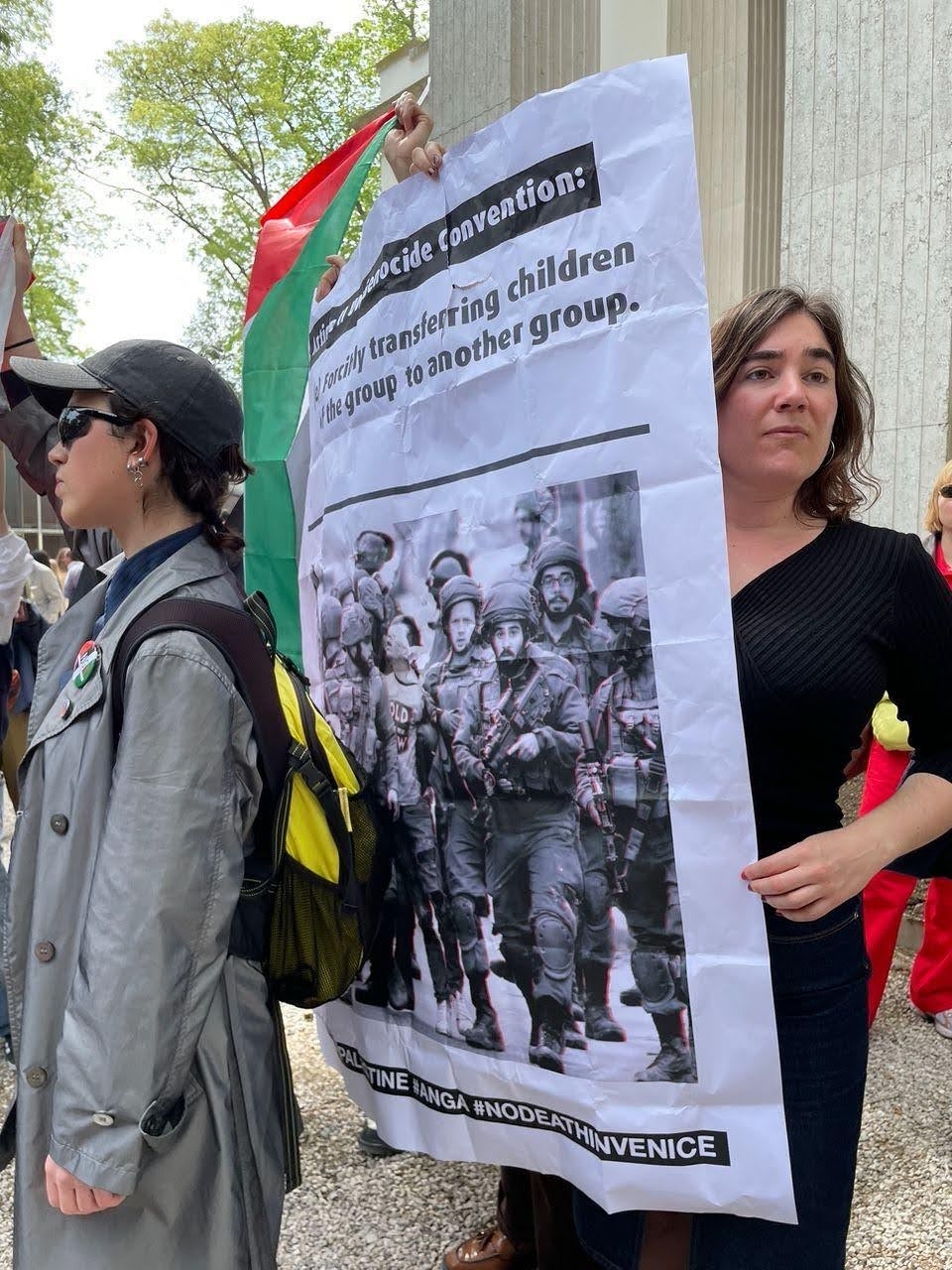
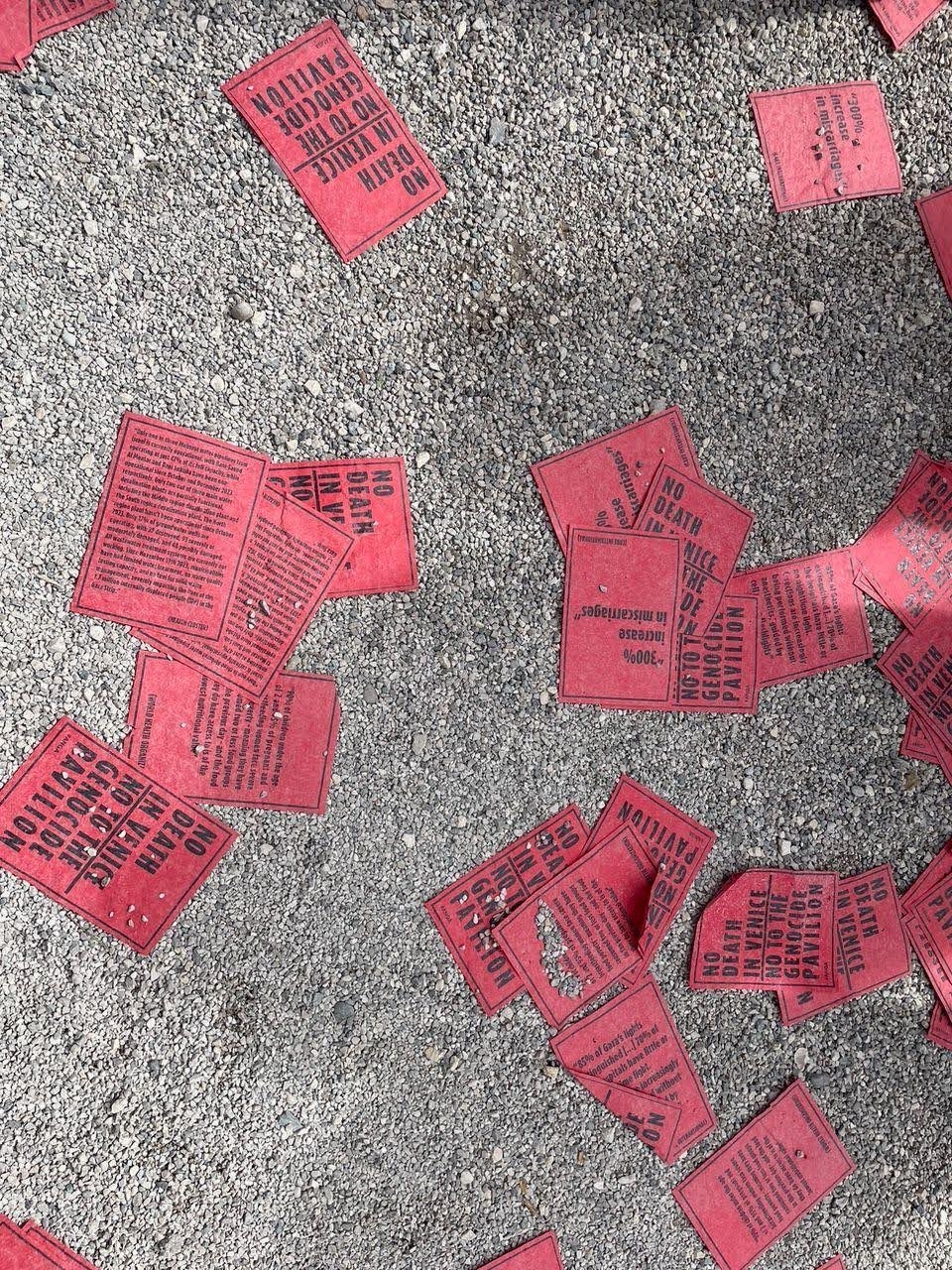
At the 60th Biennale preview:
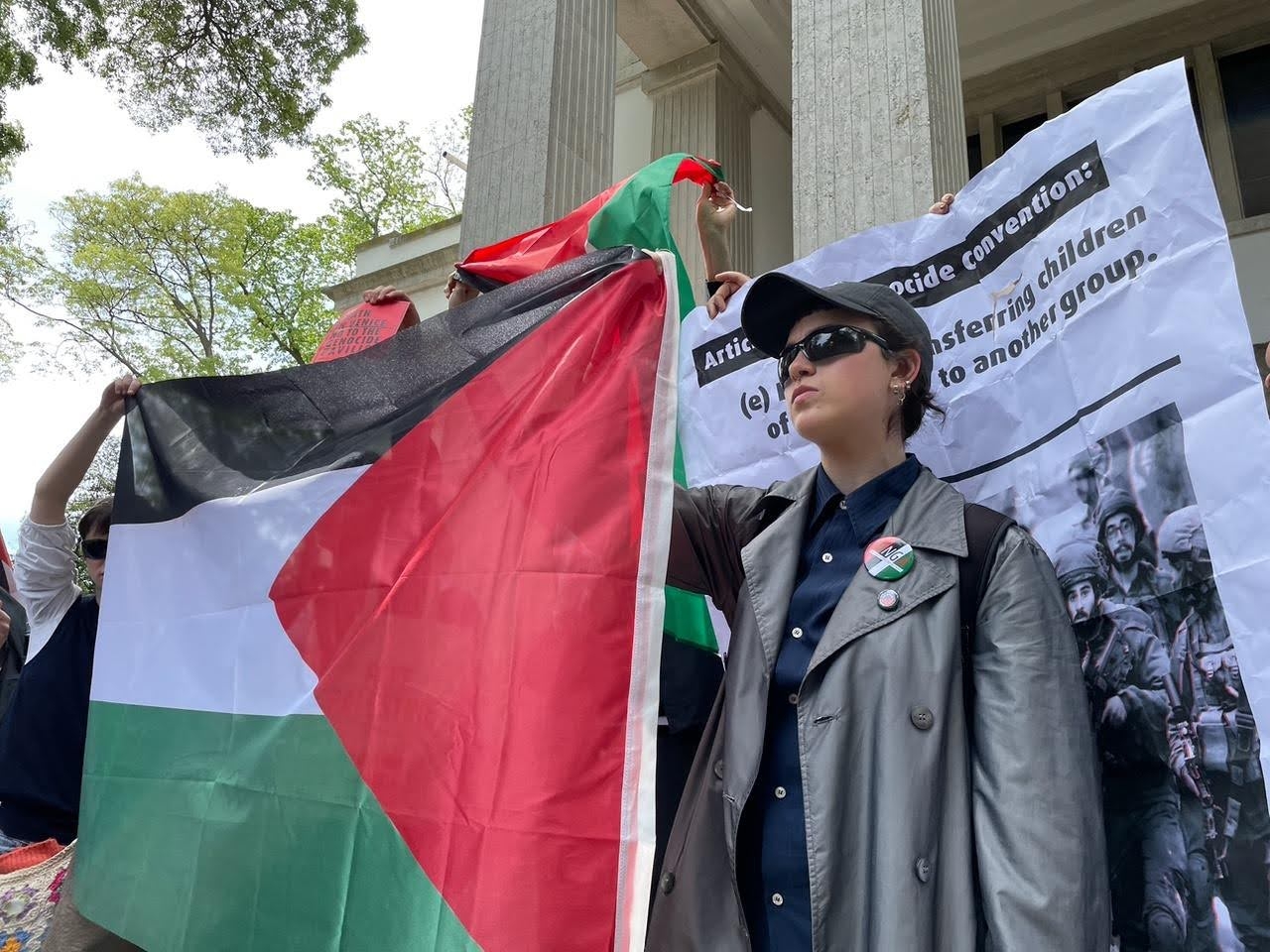
(Above) Participant in the Palestine solidarity demo staged at the Giardini holds up a placard showing Article 2 of the UN Genocide Convention.
(Below) Flyers distributed by the demo organizers saying “No Death in Venice / No to the Genocide Pavilion.”
The artist Ruth Patir representing Israel at the Biennale, firmly opposed to these cultural boycotts yet openly critical of her own government, reasoned she could only do what she could with the place she had been given, and made the decision to close the pavilion. (Editor’s note)
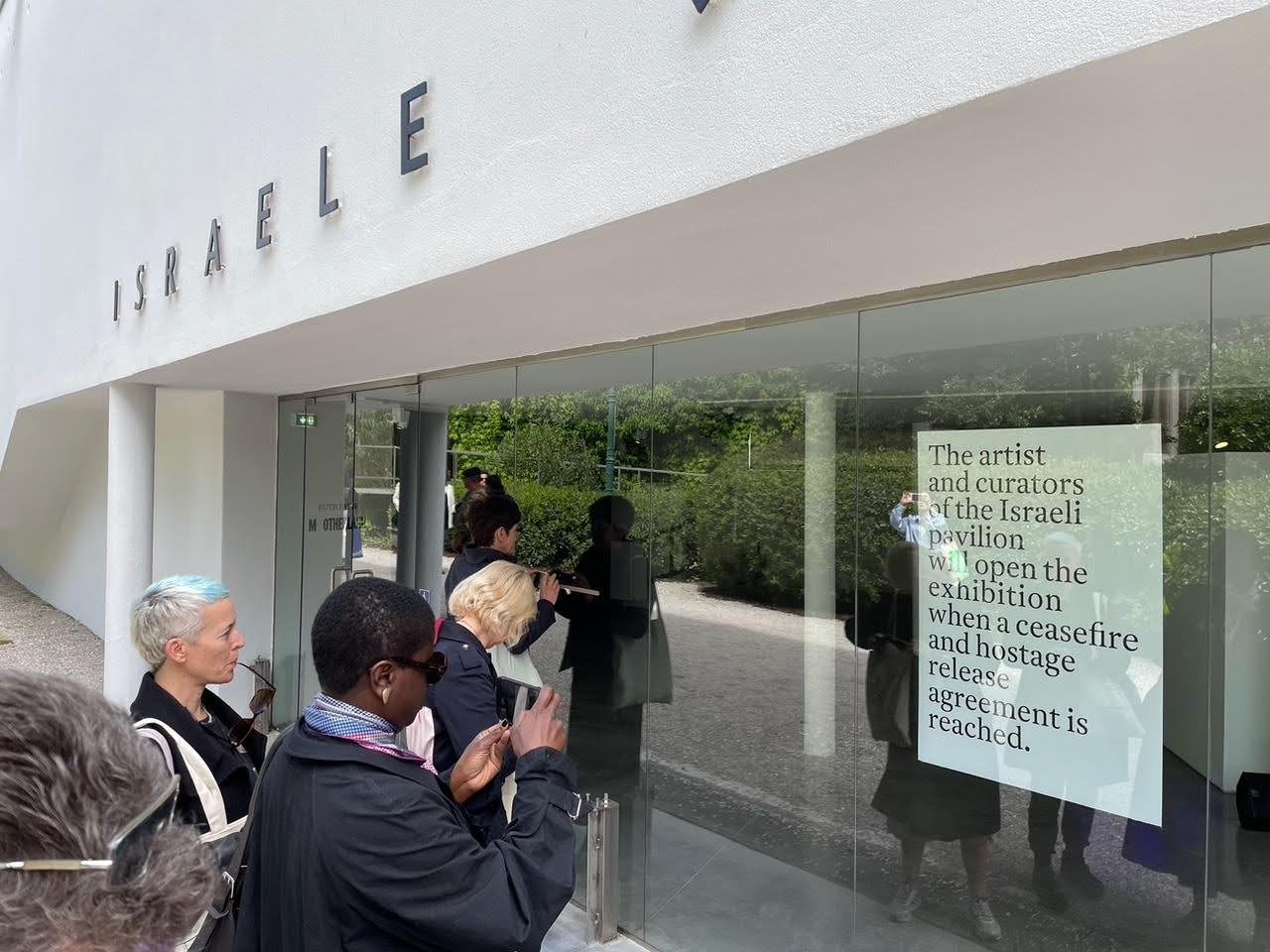
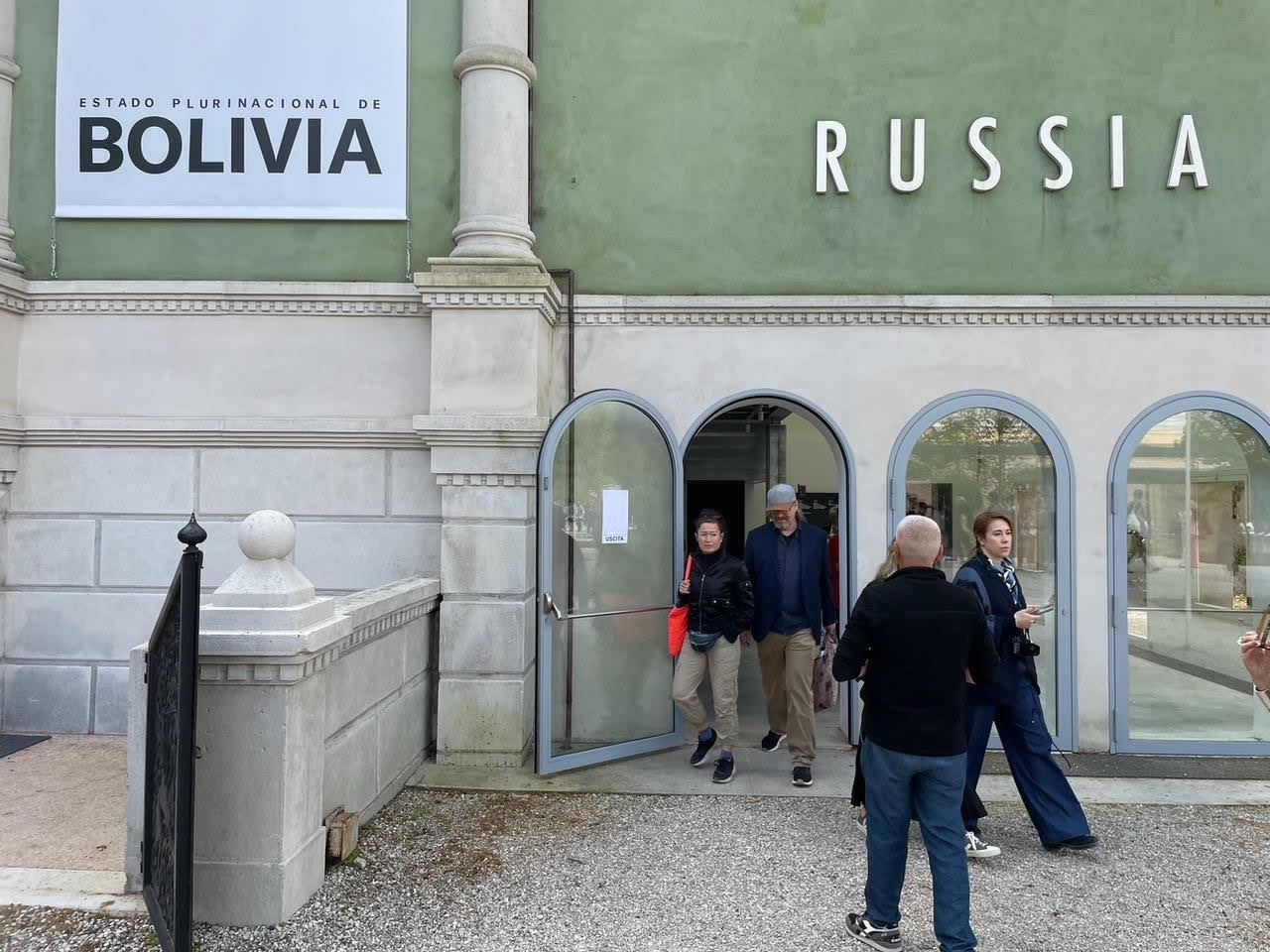
At the 60th Biennale preview:
(Above) The Israeli pavilion was off limits, with only the ground-floor interior visible through the glass.
(Below) After Russia pulled out, its pavilion was leased to Bolivia.
The double standard displayed here by the EC and Italian government would be obvious even to a middle schooler. The only party in this sorry saga that could not be accused of double standards is the Venice Biennale Foundation.4 In late February 2024 it issued a statement noting that “all Countries recognized by the Italian Republic may autonomously request to participate officially.”5 Thanks to this policy (or perhaps rather thanks to the heads of Russia, Israel, the US and Iran, all of whom morally, would be inferior to any random middle schooler), at this year’s Venice Biennale we may witness the unusual sight of active combatants—Ukraine, Russia, Israel, the United States, and Iran—setting up shop alongside each other. Not to mention Palestine, which like last time will take part in the collateral events.
Much like the Olympics, the Venice Biennale, where each country has its own pavilion, is prone to double standards. There are always background complexities, and the varying standpoints of artists, curators and other art-world figures, plus the spectators, mean responses to such issues will vary. Here I therefore state only my personal opinion, which I have no desire to push on anyone. That is, when it comes to such questions of where to draw the line, I prefer to draw on the wisdom of two forebears: Edward Said (1935–2003), and Simone Weil (1909–1943).Arguing that “the intellectual today ought to be an amateur,”6 Said expanded the conventional image of the intellectual. According to him, amateurism is “an activity that is fueled by care and affection rather than by profit and selfish, narrow specialization,”7 and the public role of the intellectual is, in simple terms, to be an outsider, an “amateur,” a disturber of the status quo.8 Note that “intellectual” as defined by Said naturally includes the likes of artists and art specialists, and also probably encompasses art lovers of a critical bent.
Born into a Jewish household, Simone Weil nevertheless loathed the Israeli belief that Jews are God’s chosen people. She grew up in a Christian culture, but concluded that “[u]nconditional love of the [Catholic] Church is idolatry.”9 A student of Marxism, Weil labored in factories and denounced Stalinism, while also wanting to share with her fellow workers the rationalist thought of Descartes, and modern science. Simultaneously convinced, mathematically, of both the existence and absence of God, she wrote “I have to be atheistic,”10 yet believed in that higher power.
The life of this conscientious woman who lived in poverty and died at the age of 34, weakened by malnutrition, stands in sharp contrast to those of politicians mired in allegations of sex crimes or the murder of political opponents, seemingly trying to best each other in lying, legal trickery, tax evasion, corruption, abusing their position, nepotism, crooked influence peddling, discrimination, oppression, inciting violence, and ignoring international law. Like Said, who fought tirelessly for minorities, Weil, I believe, was a true, trustworthy intellectual.
Noting “[o]bedience to a man whose authority is not illuminated by legitimacy—that is a nightmare,”11 Weil wrote that “[d]eath is the most precious thing which has been given to man. That is why the supreme impiety is to make bad use of it.”12 and “War…. never to inflict death without accepting it for ourselves.”13 Sentences I would love the heads of Russia, Israel, the United States, Iran and a few more places to read, but at least one of these men lacks even the intellectual capacity of a middle-schooler, so even if he did read them, would be unlikely to understand.
If one were to heed these two wise individuals, the proper thing to do would surely be to loudly reject all things Russian, Israeli, American, or Iranian. The Russian pavilion is being run by a firm contracted by the Russian ministry of culture and foreign ministry; the Russian commissioner is the daughter of the deputy CEO of a state-owned defense conglomerate, and her partner in the company running the pavilion is the daughter of the Russian foreign minister.14 The Israeli pavilion has also received funding from the country’s foreign ministry and ministry for sport and culture. The US pavilion is overseen by a non-profit organization, but its content is subject to the approval and oversight of the State Department’s Bureau of Educational and Cultural Affairs. Iran’s pavilion is the responsibility of its Ministry of Culture and Islamic Guidance. Every one of these pavilions is supported by the government of a state that brings “misery and oppression” 15 to those from other countries and their own, and “inflicts death.”
As of mid-March, other countries engaged in war or civil conflict include Pakistan, Somalia and Syria, but here I should like to make special mention of Saudi Arabia. As Deputy Prime Minister, the Crown Prince and Prime Minister Mohammed bin Salman, de facto ruler of the Gulf nation, ordered military intervention in the Yemeni civil war, triggering a tragic situation in Yemen that includes serious food shortages. On the other hand, he declared a return to “a moderate Islam open to the world and all religions,”16 and leads the “Saudi Vision 2030” economic, social and cultural program designed to reduce the kingdom’s dependence on oil and diversify its economy and society.
Bin Salman has featured frequently in the news, including for paying the highest-ever price for a painting at auction with the purchase of Da Vinci’s Salvator Mundi. But never forget: this is the man responsible for the killing of fellow Saudi and journalist Jamal Khashoggi. Khashoggi was a critic of both his government’s system and the president-who-shall-remain-nameless with less intellectual and moral bandwidth than a middle-schooler, and in October 2018, went missing on a visit to the Saudi consulate in Istanbul to file the paperwork for his upcoming nuptials. The Turkish authorities, who were bugging the consulate, revealed that Khashoggi had been tortured and strangled to death. His body is thought to have been dismembered and dissolved in acid. A trial was held in Saudi Arabia, five Saudi operatives receiving the death sentence (later commuted), but any suggestion that Bin Salman had instructed them to kill Khashoggi was rejected. The CIA and UN concluded that he was in fact involved in the murder, but the sub-middle-schooler president, who had an arms deal with the Crown Prince, ignored this conclusion.17
As part of “Saudi Vision 2030,” since 2021 Saudi Arabia has staged the Noor Riyadh light art festival.18 Curators from different countries cooperate in the festival, and numerous artists take part, but does no one remember the Khashoggi case? Or are they not aware that the Crown Prince is organizer of the festival? As mentioned above, people decide to behave as they do for various reasons and based on various values, and I have no intention of pushing my views on to anyone. But an understanding of the incident, or a lack thereof, could potentially have been a major determinant of people’s actions here.
Incidentally the exhibits in the Russian pavilion were apparently inspired by the writings of Weil.19 In 2020 Thomas Hirschhorn created the “Simone Weil-Map,”20 while at last year’s Okayama Art Summit, Philippe Parreno, who also served as artistic director, teamed with media company Isolarii to translate and publish Decreation, a collection of Weil’s writings.21 Just quietly, it seems that trustworthy intellectual’s time may have come, in the art world at least. Which in this day and age, can only be good news.
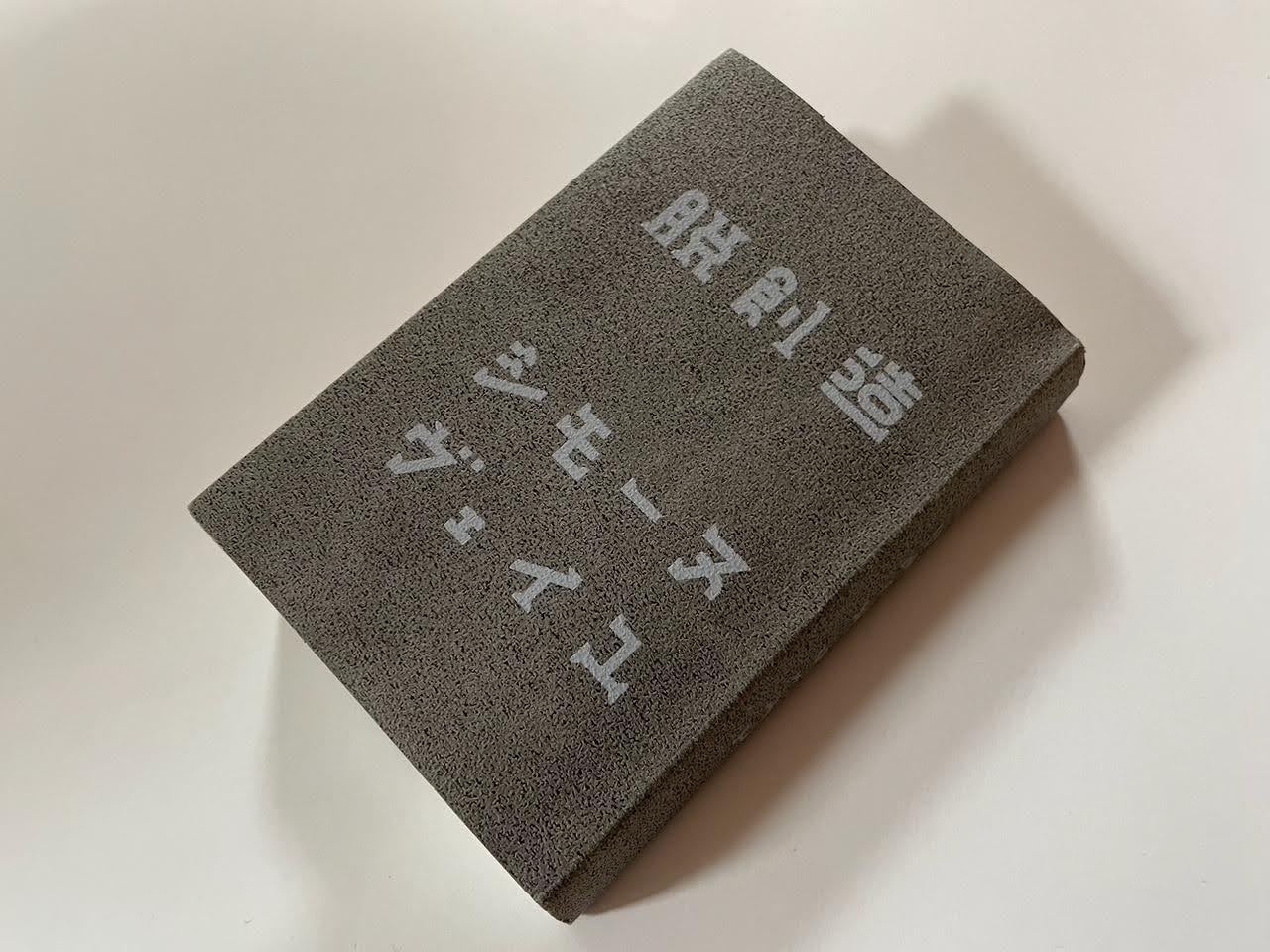
Simone Weil, Decreation, edited and published by Isolarii and Philippe Parreno, 2025
1. Ministry of Culture of the Republic of Latvia, “Ministers from 22 countries urge Venice Biennale to reconsider Russia’s participation,” March 10, 2026
2. European Commission, “Statement by Executive Vice-President Virkkunen and Commissioner Micallef on Russia’s participation at the Venice Biennale Art Exhibition,” March 10, 2026
3. Serge Duchêne with AFP, “Russia returns to the Venice Biennale amid fierce criticism,” in euronews, March 7, 2026
4. 財団理事長は親ロシア派として知られるジャーナリスト/作家/演劇人で、2015年にイスラム教に改宗している。「[自分の故郷]シチリアのアイデンティティはイスラム的だ」というのが理由で、同州知事選の右派連合候補として名前が挙がったときに「キリスト教徒がイスタンブールで立候補して選ばれるみたいなもの」と友党党首の現首相に拒否権を行使されたという逸話が伝わる。イスラム教徒の社会民主主義者がニューヨーク市長になったいま、首相の見解は変わっただろうか。
Philip Oltermann and Lorenzo Tondo, “Venice Biennale’s new, rightwing director has art world guessing,” in The Guardian, 18 November 2023
5. La Biennale di Venezia, “La Biennale di Venezia on the National Participations and Collateral Events,” February 28, 2024
6. Edward W. Said, Representations of the Intellectual (Vintage, 1994/1996), 82.
7. Ibid.
8. Edward W. Said, Representations of the Intellectual, trans. Ohashi Yoichi (Heibonsha, 1995), 4–5.
9. Simone Weil, First and Last Notebooks: Supernatural Knowledge, trans Richard Rees (Wipf & Stock, 1970/2015), 130.
10. Simone Weil, Gravity and Grace, trans. Emma Crawford and Mario von der Ruhr (1947; Routledge, 2003), 115.
11. Ibid., 172.
12. Ibid., 85.
13. Ibid., 86.
14. Kate Tsurkan, “What’s on at the Venice Biennale? Russian soft power,” in Kyiv Independent, March 7, 2026
15. Martin Chulov, “I will return Saudi Arabia to moderate Islam, says crown prince,” in The Guardian, October 24, 2017
16. “Khashoggi murder: Body ‘dissolved in acid’” in BBC, November 2, 2018
“Jamal Khashoggi,” in Wikipedia
17. Noor Riyadh
18. pavilion.rus, “Russian Pavilion, Giardini della Biennale.,” in Instagram
19. Thomas Hirschhorn, Simone Weil-Map, 2020
(All accessed April 7, 2026)About the series
In “Out of Kyoto” writer and art producer Ozaki Tetsuya covers topical issues in the arts and wider culture, exploring the state of artistic expression today, from an historically-informed perspective.
Ozaki Tetsuya
Writer/arts producer. Launched the online culture magazine REALTOKYO in 2000, and the contemporary art magazine ART iT in 2003. General producer of the performing arts program for Aichi Triennale 2013. Served from September 2012 through December 2020 as publisher and editor-in-chief of the online culture magazine REALKYOTO, and from February 2021 through March 2025 as editor-in-chief of REALKYOTO FORUM. Editor and author of the photo books One Hundred Years of Idiocy and its sequel One Hundred Years of Lunacy >911>311; author of Gendai āto to wa nani ka (What is contemporary art?) and Gendai āto o korosanai tame ni (So as to not kill contemporary art). Awarded the Chevalier of the Order of Arts and Letters by the French Government in 2019.