
Intersections: Meditations on Southeast Asia
Reeling in history through artistic gesture 4: Cheong See Min
By Kanai Miki
- SHARE


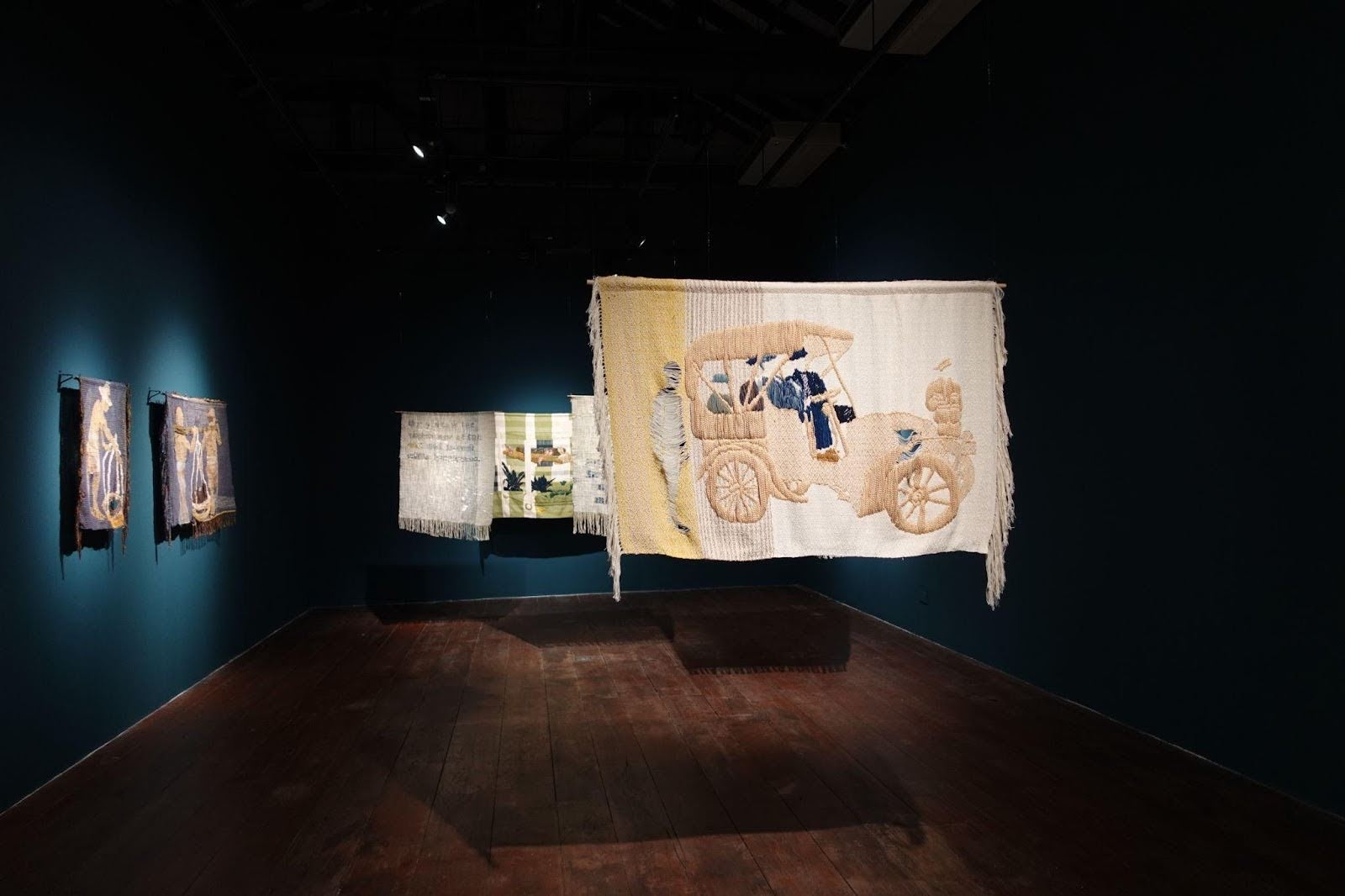
Courtesy the artist and Warin Lab Contemporary.
Memories dwelling in thread—Southeast Asian textile culture and contemporary art
Brush with a hand, and the bumps and hollows of stitching and subtle weight of thread convey time past as sensation. Hemp, silk, traces of dyeing and the irregularities of weaving hold day-to-day endeavors as memories. In Southeast Asia, textiles are intimately connected to myriad life scenarios through these material sensations, as clothing, decoration, or part of religious ritual.
In particular the work of dyeing textiles by hand, such as in batik,1 functions as a medium for relaying a communal worldview; cloaked in color and design, yet encompassing stories and symbolism. Because these are materials close to the everyday, in contact with the body, they enable modest dialogue between past and present, tradition and history. Yet simultaneously they are also the object of consumption, as symbols adorning national or touristic imagery, obscuring their individual regional characteristics and historical backgrounds.
These qualities are also attracting new interpretations in the contemporary art context. Undergoing technical, structural and conceptual changes, the medium of textiles is expanding its expressive range, becoming a foundation for contemporary creation beyond the bounds of traditional craft. Yet in institutional frameworks, textiles have consistently been consigned to the margins of art categorization.
Recent years however have seen a newfound appreciation for the medium in academic and critical contexts, thanks to an array of artist and curator initiatives. Behind this reappraisal is a change in perspectives on the international art scene. Deeper discussion of issues such as race and gender, expression rooted in the local or indigenous, and production on the theme of individual identity or nationality, are contributing to greater diversity in awareness and interests in the contemporary art world. Within this larger current in art, textiles have transcended their previous status as a peripheral form to gain renewed understanding of their significance as an expressive medium.
Weaving spaces – the installations of Cheong See Min
The textile works of Malaysian artist Cheong See Min featured here take as their starting point the artist’s own childhood memories, and give weight to the meticulously researched tracing of historical background. The trajectories of Cheong’s contemplations are woven skillfully into the works, showing the connections between personal experience, and social/historical events. Things previously overlooked slowly manifest from the midst of colors and textures, and the subtle fluctuations of thread.
The exhibition “Inventory of Intimacies” staged at Kuala Lumpur’s The Back Room2 in June 2024 was a group show by three emerging artists, dominated by introspective works using textiles to express the texture of memories and personal histories. Among these, the small works by Cheong See Min at first glance presented a rough, coarse woven structure, in which the subject depicted and specific details of the narrative were not immediately obvious. While this coarseness and lack of clarity may have been indicative of the expressive technique deployed by the artist here, they also left room for the viewer to reconstruct fragments of the story in their own way.
The techniques used to display works were characterized by multiple variations on arrangement and form, and in the group of works suspended from the ceiling, the exposure of the reverse sides revealed the duality of front and back, and the fragmented nature of the images, giving the works a heightened presence in the space. Works affixed directly to the walls meanwhile, generated a subtle disconnect between their materiality as woven fabric, and the display environment of the wall, creating a hint of dissonance. In both cases, the weight of time and degree of touch involved in production were conveyed through the traces of handwork, in contrast to calculated mechanical perfection. This quality gave viewers a feel for the material existence of the textiles.
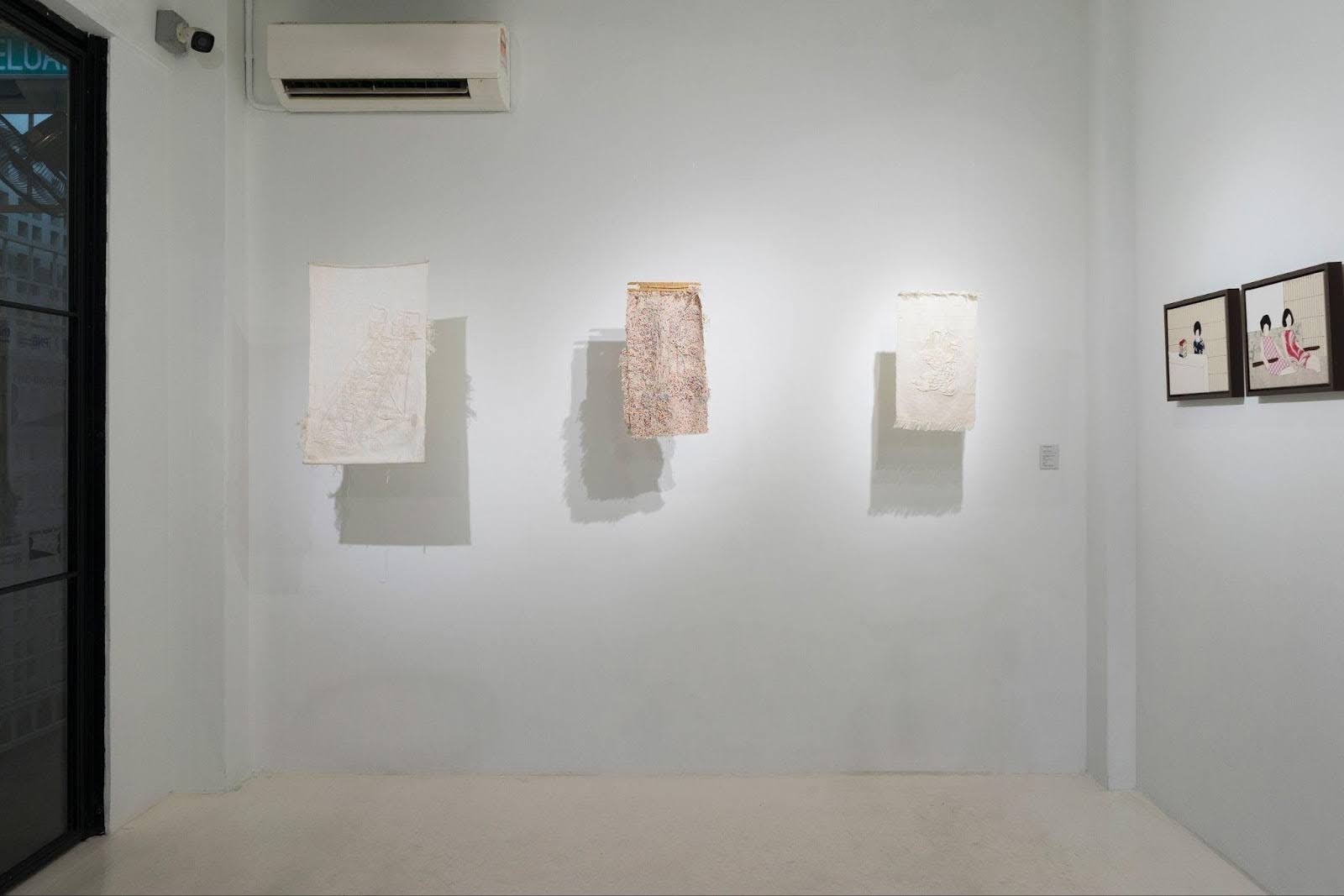
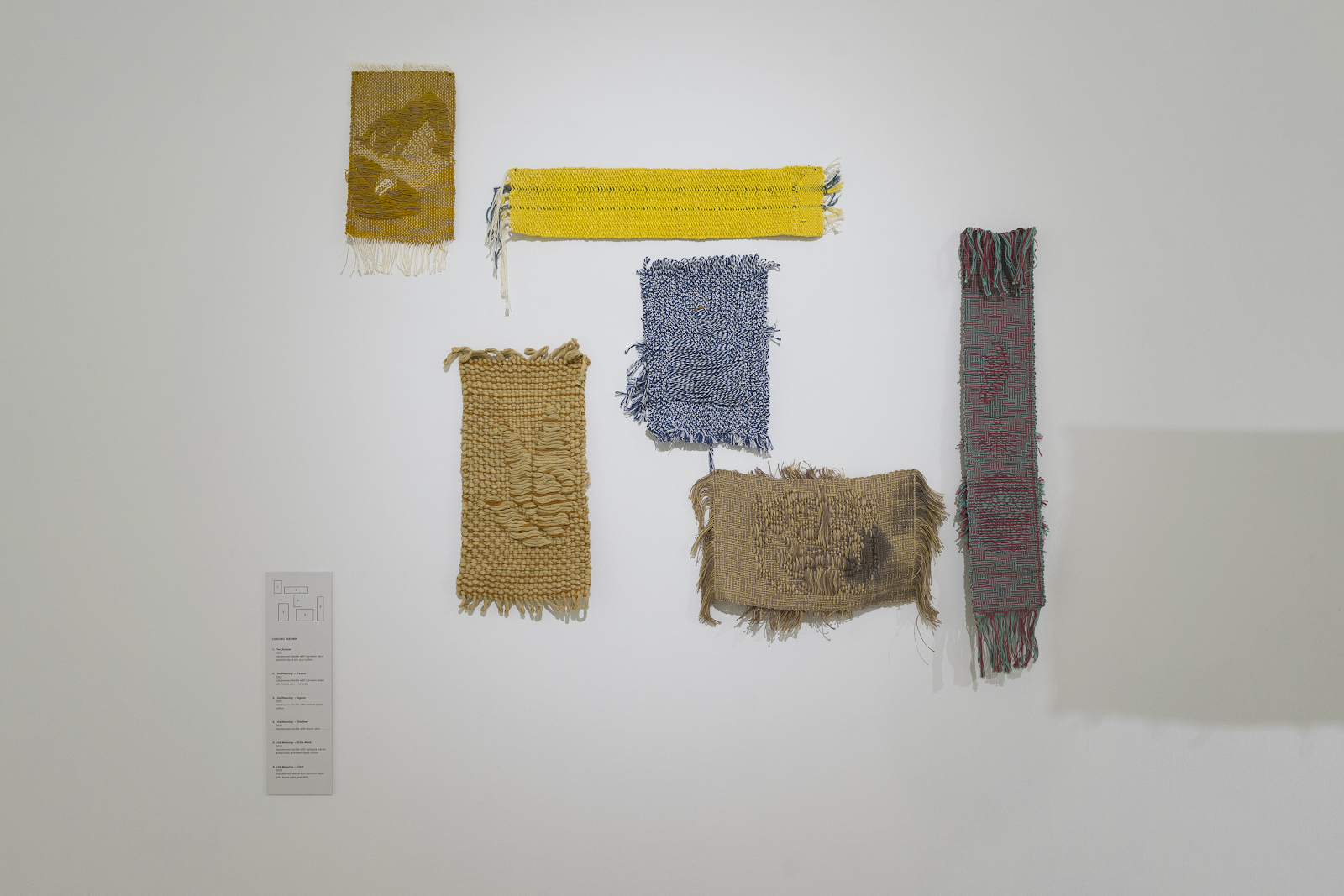
Installation views of “Inventory of Intimacies” at The Back Room.
Works suspended from the ceiling (top photo) by Cheong See Min.
Photos: Kenta Chai, courtesy the artist and The Back Room.
In the shadow of a fruit—public and personal history courtesy of the pineapple
My next encounter with the works of Cheong came courtesy of the solo show “After the Pineapple” at Warin Lab Contemporary3 in Bangkok. While retaining the strikingly structured and fragmented quality of the previous exhibition, here the narrative organization across the works was clearer. As the title indicates, the theme for the show was historical associations around pineapple.
The predominant images of the pineapple are related to its consumption, whether of the fruit itself, or perhaps the pineapple cake marketed as a tourist souvenir. In the Japanese context at least, the association of such imagery with the history of colonial power, or plantation labor, is not immediately obvious. Rather than explicitly highlighting the vivid yellow flesh of the fruit, or its emblematic form, by shifting her gaze instead to pineapple leaf fiber as a material, or traces of dyeing, Cheong conjures from the material dimension memories of land, labor and the colonial period.
Memories of the pineapple farm in Johor, Malaysia where her mother and grandmother were employed, scenes from her childhood, and plantation documents from the period of Japanese control viewed during research in Taiwan, do not simply present historical fact, but form multiple temporal strata mingling personal and colonial history. Thus though grounded in a specific regional past, they serve as devices to visualize the unfolding of the plantation economy, and the legacies of imperial control.
While undertaking her research, the artist learned that pineapple leaf fiber harvested in Taiwan when the island was under Japanese control was sent to Japan for use in the emperor’s garments. This discovery prompted a deeper investigation, and the resulting historical and material insights were reflected in the choice of materials, the textures, and depictions of works in the exhibition space.
In the dimly lit gallery, works were suspended from the ceiling, and textiles arranged on walls. Due to the interplay of light and shadow Cheong’s works seemed to float in the air like frames from a film running on a projector, the material presence of the textiles radiating vitality. The thickness of the thread and differences in color produced a three-dimensional rhythm, the lack of uniformity characteristic of handcraft serving as breath. Revolving around the figures of people laboring on plantations, the works portrayed memories of the past, the afternotes of these stories lingering in the gallery space.
We walk barefoot, they sit in the car is based on archival material related to the plantation economy of Thailand, and juxtaposes the foreign rulers in a vehicle, and local people standing unshod. The local people are depicted in a simplistic style, represented almost as voids. This lack of balance in the composition lays bare the physical distance and social chasm between the parties, reflecting a shadowy side of historical/social conditions.
The publication Singapore Directory for the Straits Settlement 1879 was compiled from the viewpoint of a British-dominated colonial society in the Straits Settlement colony of the second half of the 19th century. Cheong’s Restless Soil series, in which this English-language text is woven from pineapple leaf fiber, a natural dye; cotton thread, and gold foil, sat suspended in the center of the space. As one approaches, faint, transparent letters appear with the changing angle of the light. What they reveal however are sardonic statements dismissive of the local population. The numerous pins stuck in the front side of the work evoke the actions of colonial masters making marks on the map to denote possession or administration, establishing in the space, both visually and haptically, a shape for the land in which discourse and domination overlap.
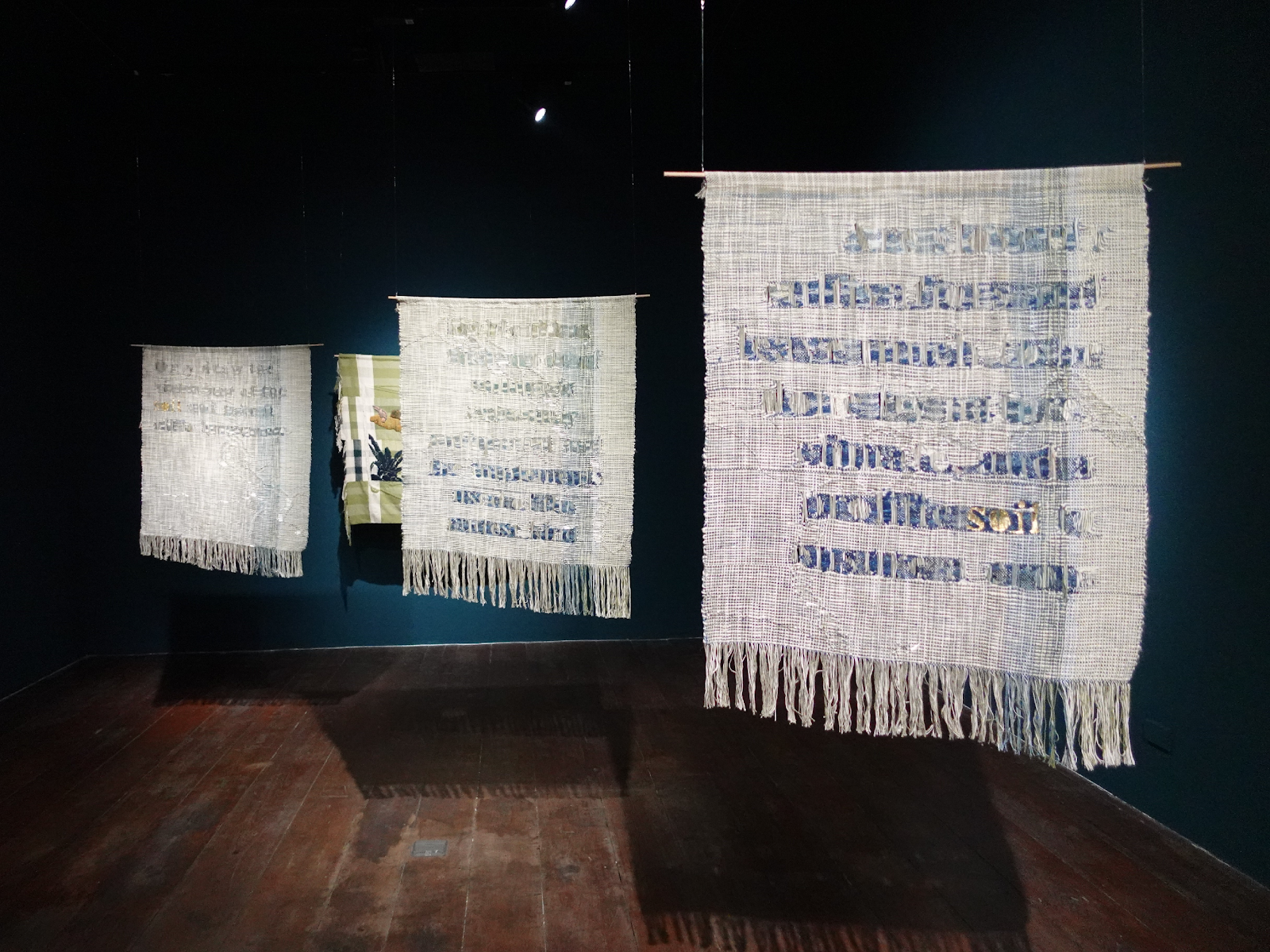
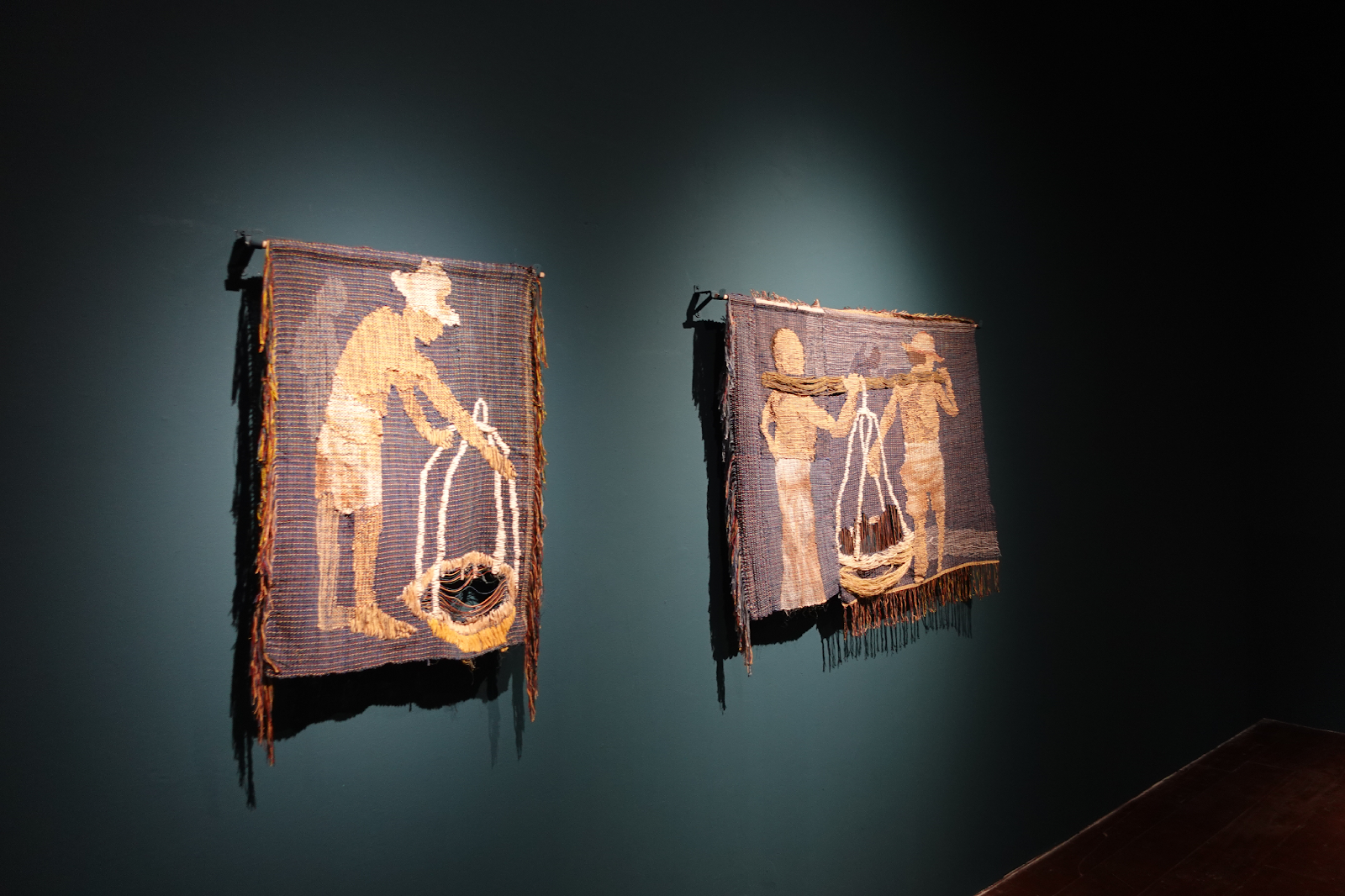
Cheong See Min, (above, left to right) Restless Soil I, II, III (2024); (below, right to left) The Lost Pineapple Cannery I and II (2025). Installation views at “After the Pineapple” (2025), Warin Lab Contemporary. Photos courtesy the artist and Warin Lab Contemporary.
Cheong’s practice unravels, from a postcolonial perspective, the manner in which discourse shaped during the colonial era has seeped into everyday representation and material culture, subconsciously reflecting social and cultural power structures, and imbalances. The artist does not merely present such historical or archival documents; by adapting them into the touch-based material of textiles, she succeeds in relativizing the supremacy and rigidity of colonial discourse.
The second floor of the gallery also featured a display of archival material, including family snapshots from the pineapple farm, colonial-era photographs and postcards collected at museums in multiple countries, material gathered by the artist in recent years in Indonesia and China, and textile samples. These materials, production processes, feel and intricate structure of the fibers, not only convey history but show the artist’s research methods and process of trial and error. Engaging with them alongside the works on the ground floor allowed visitors to trace in a more three-dimensional fashion the process by which the artist undertook a critical unpacking of historical ephemera, turned it into material, and composed it as an inquiry.
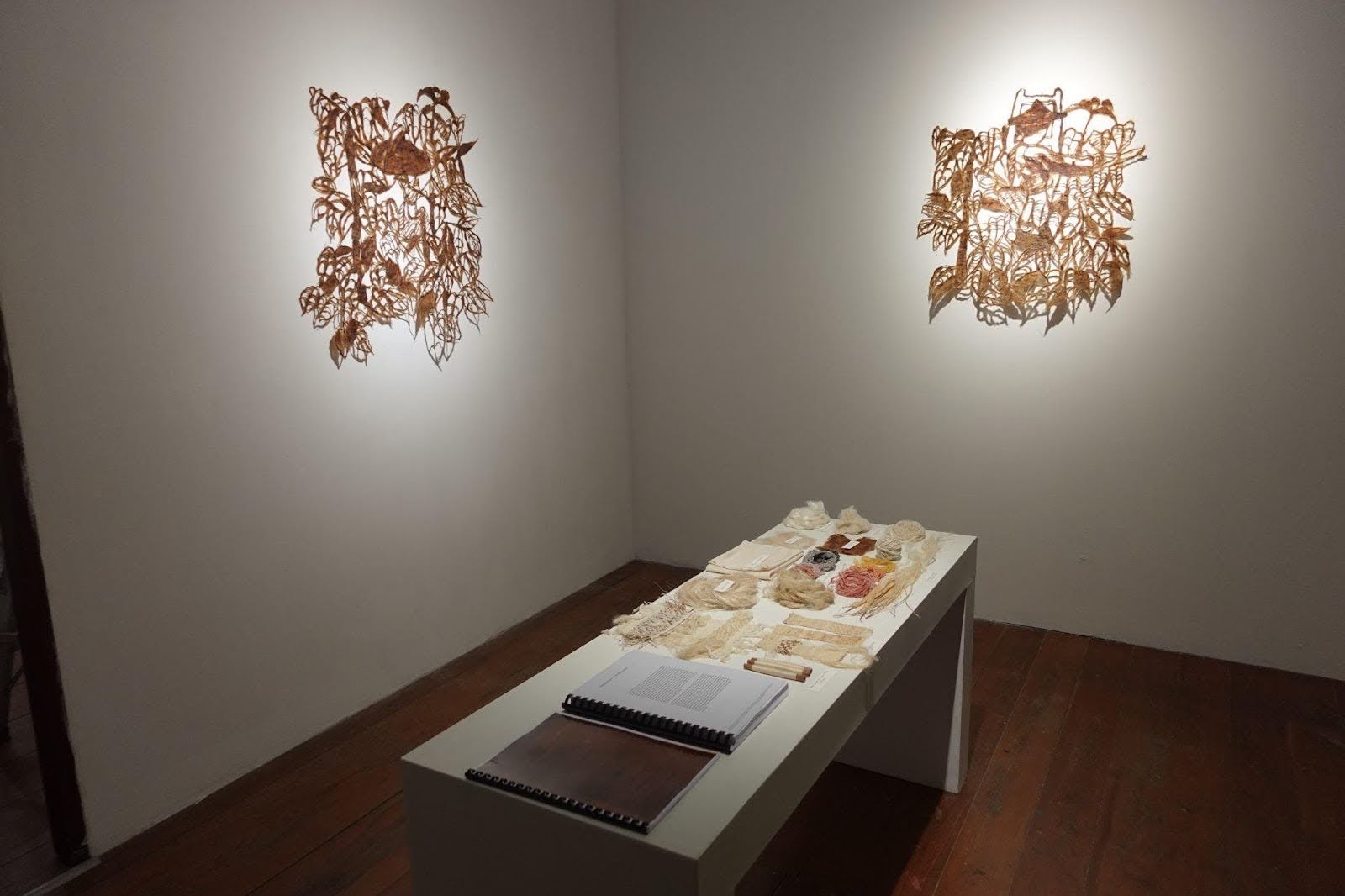
Second floor gallery display of archival material at “After the Pineapple” (2025), Warin Lab Contemporary. Courtesy the artist and Warin Lab Contemporary.
The feel of history—a further encounter with threads and memories
My third encounter with Cheong’s work was also at a textile-themed group show. Among offerings with color and clear social messaging at front and center, Cheong’s Untitled – House woven from hemp and silk stood out for its more understated look.
Superficially no more than the form of a small house, what this work depicts is the modest living space of the migrant workers who lived on plantations. The neat, crisp stitching in hemp and silk at first seemed somewhat sterile, but therein lay the harshness of those lives. As the relationship between visual form and background story is unraveled, the existence of the workers gradually becomes apparent on a material and corporeal level.
This restrained gesture defines the heart of Cheong’s expression. Though grounded in historical record and human testament, Untitled – House converts this to bodily sensation, offering it up as something that feels different to the historical narratives espoused by louder voices. The subtle oscillations deep in the stitching link individual memories with the social structure of the colonial era, allowing the viewer to experience echoes of history through the materiality of the textile.
Even in a work unable to be touched, the up and down of stitching and weight of thread summon up sensation, throwing into relief not the past per se, but contours of history that remain partly elusive. Those contours continue to fluctuate in our own time, never quite fully in our grasp, nor entirely unraveled.
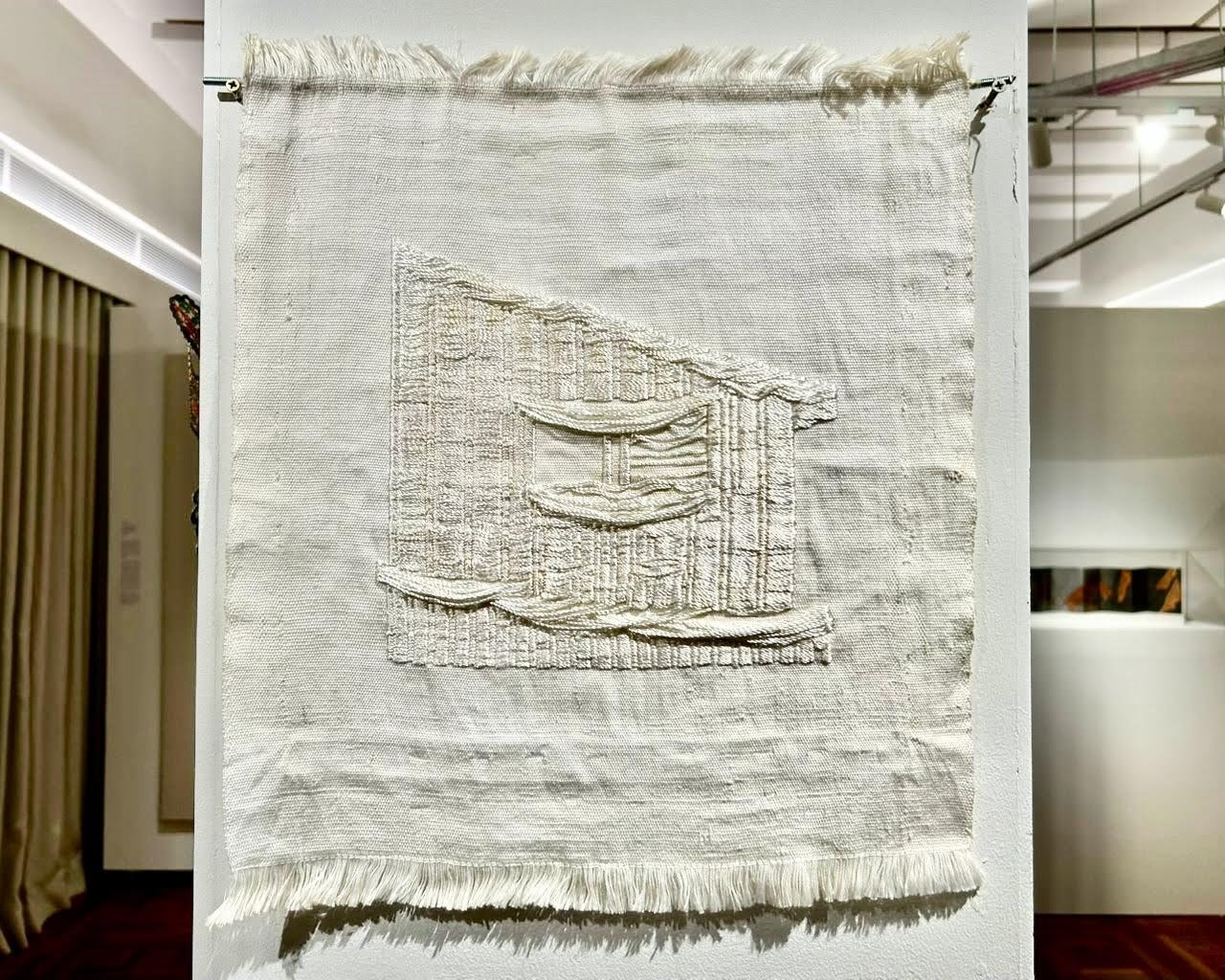
Cheong See Min, Untitled – House, 2020. Installation view at “ASEAN Art & Textiles: A World of Seams and Seamlessness” (2025) at Yap Ah Shak House in Kuala Lumpur; curated by CULT Gallery and Samyama by John Ang.
Photo: the writer.
1. Fabric traditionally made in places like Malaysia and Indonesia using wax-resist dyeing techniques. Of national artistic and cultural significance, batik was accorded UNESCO Intangible Cultural Heritage status in 2009.
[*2]The Back Room
[*3]Warin Lab Contemporary:After the Pineapple
(All accessed March 12, 2026)About the series
“Intersections: Meditations on Southeast Asia” is a series by Malaysia-based arts and culture researcher Kanai Miki, in which she unpacks the art of Southeast Asia from multiple perspectives, including those of history, regional characteristics, and solidarity among peoples, contemplating the relationship between Southeast Asia today and art, including from a Japanese perspective.
Kanai Miki
A researcher of arts and culture, Kanai documents and analyzes artistic and cultural phenomena first hand as a journalist, and links this practical knowhow to her studies. Following an MA in 20th-century art history at Goldsmiths College, University of London, she spent around two decades based in Berlin, covering the art scene closely in over 20 European countries. Two years of this period were spent as a Japanese Agency for Cultural Affairs Program of Overseas Study for Upcoming Artists grantee (art criticism). Kanai has written for a number of Japanese art magazines including Bijutsu Techo, Geijutsu Shincho and ART iT, and also for cultural magazines such as Seikatsu Kosatsu and Studio Voice. She has introduced the European art scene and European artists to Japan through the writing and editing of books, websites, and exhibition catalogues, and as an exhibition coordinator. Currently based in Malaysia, in addition to research and writing she also helps to organize exhibitions and workshops. Member of the German branch of the International Association of Art Critics (AICA).