
Out of Kyoto
007 Critiquing “Marcel Duchamp” @ MoMA without actually seeing the show
By Ozaki Tetsuya
- SHARE


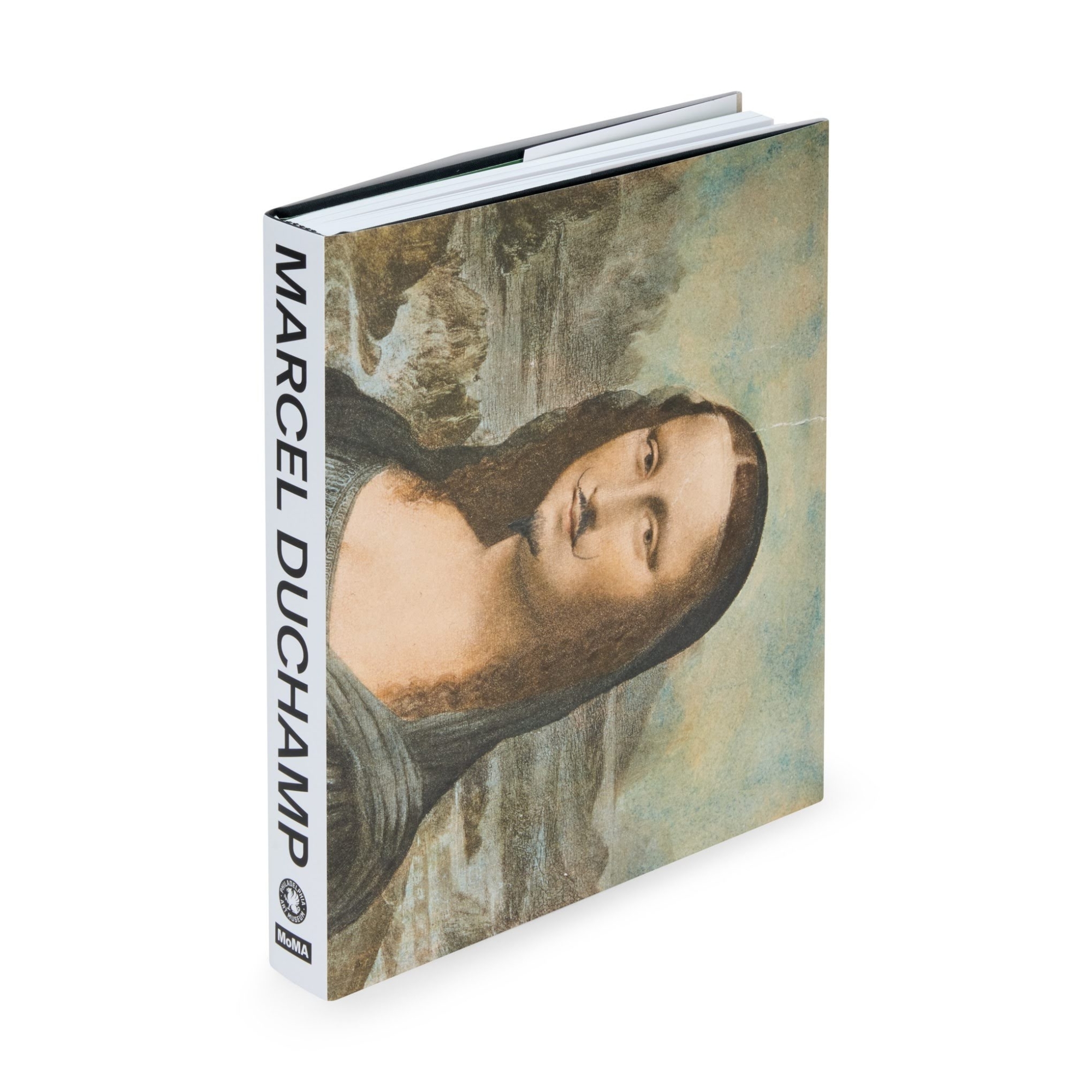
Marcel Duchamp (1887–1968) is an artist who is the bane of museums and museumgoers. In absolute terms his works number very few.1 A mere handful of the original readymades remain. Signature work The Large Glass aka The Bride Stripped Bare by Her Bachelors, Even (1915–23), and the posthumous Étant donnés: (Given: 1. The Waterfall, 2. The Illuminating Gas) (1946–66), whose existence only came to light after Duchamp’s death, cannot be moved from the Philadelphia Museum of Art.2 Excluding the paintings from prior to 1912 that the man himself referred to as “swimming lessons,”3 almost every extant work is merely a study for one of the above two.
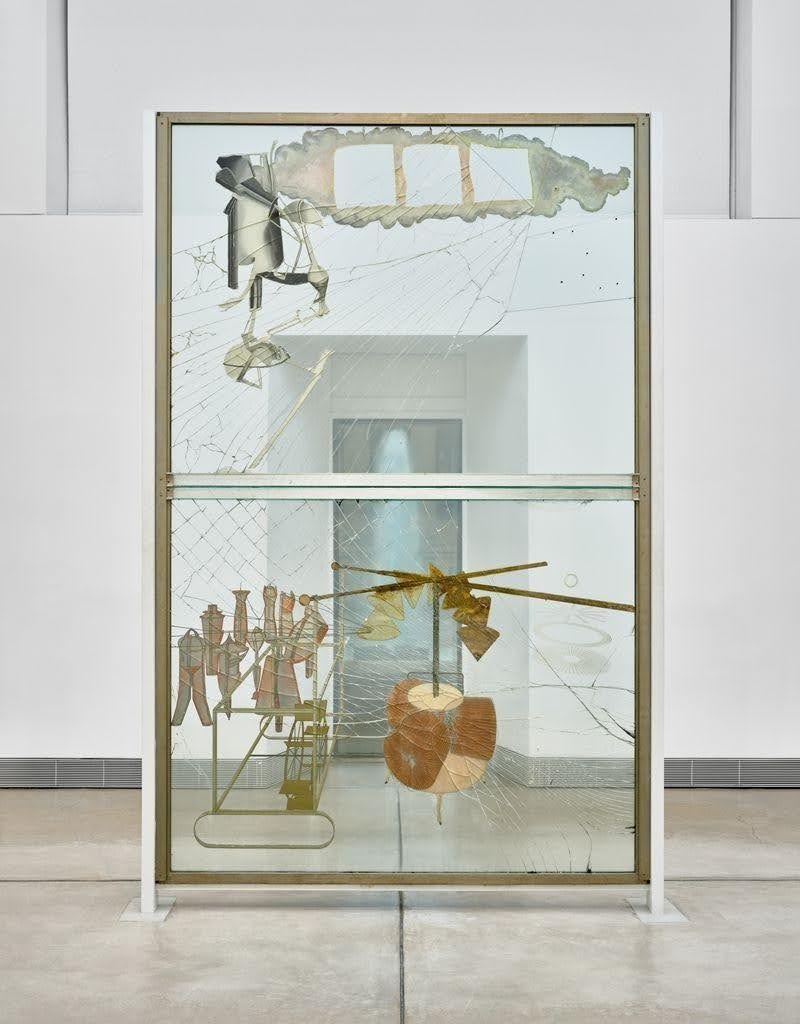
Marcel Duchamp (1887–1968), The Bride Stripped Bare by Her Bachelors, Even (The Large Glass), 1915–1923. Philadelphia Museum of Art, Bequest of Katherine S. Dreier, 1952,1952-98-1.
©Association Marcel Duchamp/ADAGP, Paris/Artists Rights Society (ARS), New York 2026
To stage any major retrospective outside of the PMA would seem largely impossible, but over the years exhibition planners around the world have racked their brains and gamely given it a go. “Marcel Duchamp”4 starting at the Museum of Modern Art in New York in 2026 before traveling to the PMA and Grand Palais in Paris into next year, foregrounds “the physicality of … facsimiles while also presenting other aspects of his work that have often been deemed peripheral, such as designs for posters and publications.”5 Like the Marcel Duchamp exhibition staged by Frankfurt’s Museum für Moderne Kunst in 2022,6 this aligns with the investigation by Kunstmuseum Basel director Elena Filipovic detailed in her book The Apparently Marginal Activities of Marcel Duchamp.7
This exhibition duly features around 300 items ranging from early drawings to photographs from a manual for installing the posthumous work. Aside from paintings it consists mainly of studies, replicas, and ephemera. Not as prodigious in scope as the 700 items at the MMK show, but noteworthy in that the exhibits are arranged not by theme, but in chronological order, with subdued lighting reinforcing the impression of an archival show. By taking this strictly chronological approach, the exhibition “aims to shed light on the wholly unpredictable, seemingly nonlinear evolution of an artistic project.”8
This means that Fountain (1917), of which the original no longer exists, appears first of all in a photograph from when it was created,9 then much later as a replica from 1950, then a little after that, one from 1963. The 1950 version was purchased by a gallerist at a Paris flea market, and the 1963 version spotted by a Stockholm curator in a local restaurant. The spectator is compelled to ponder the peculiar notion of contrasting a readymade and its replicas, by comparing a photograph they saw perhaps half an hour earlier, a product seen a few minutes ago, and another in front of them now. This certainly keeps things interesting.10
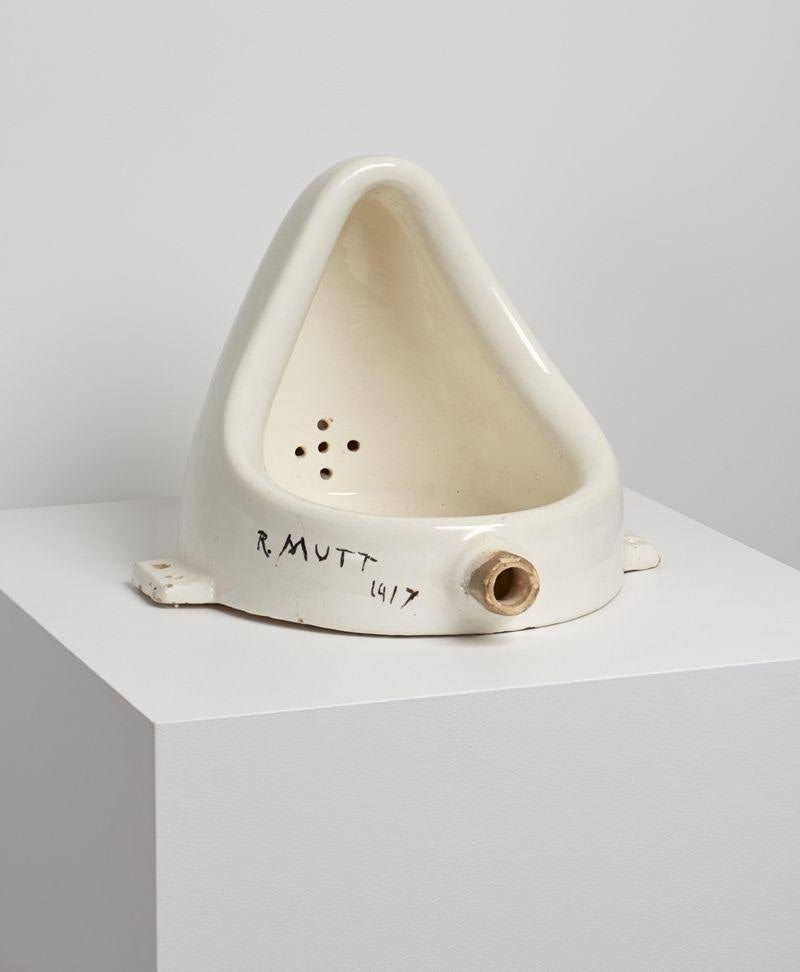
Marcel Duchamp (1887–1968), Fountain, 1950 (replica of 1917 original). Philadelphia
Museum of Art: 125th Anniversary Acquisition, Gift (by exchange) of Mrs. Herbert Cameron Morris, 1998, 1998-74-1.
© Association Marcel Duchamp/ADAGP, Paris/Artists Rights Society (ARS), New York 2026
Bottle Rack (1914) for which no original exists either, is just as interesting. There is an initial replica from 1921, plus four other copies from 1959, 1961, 1963/76, and 1963, which thanks to their temporal proximity, by happy accident mesh with the “chronological” approach of the exhibition, and are displayed in a row. At MMK too, readymades of various sorts were arranged alongside each other, but intriguingly the four Bottle Racks here clearly have different shapes, or strictly speaking, differ in their horizontal and vertical proportions.
The 1959 edition is a little taller. This one is said to have been chosen by Duchamp from several he had Man Ray send him from Paris. The provenance of the 1961 version is unknown. Gifted to the PMA by Duchamp’s wife Teeny, it is somewhat stockier, as if squashed from above. The ’63/’76 version is a replica custom-made for a Stockholm gallery, so a replica of a replica, and of average build. The final, 1963 version, was purchased second-hand by a gallerist in Pasadena, and appears exceptionally trim. All are works officially authorized by Duchamp.
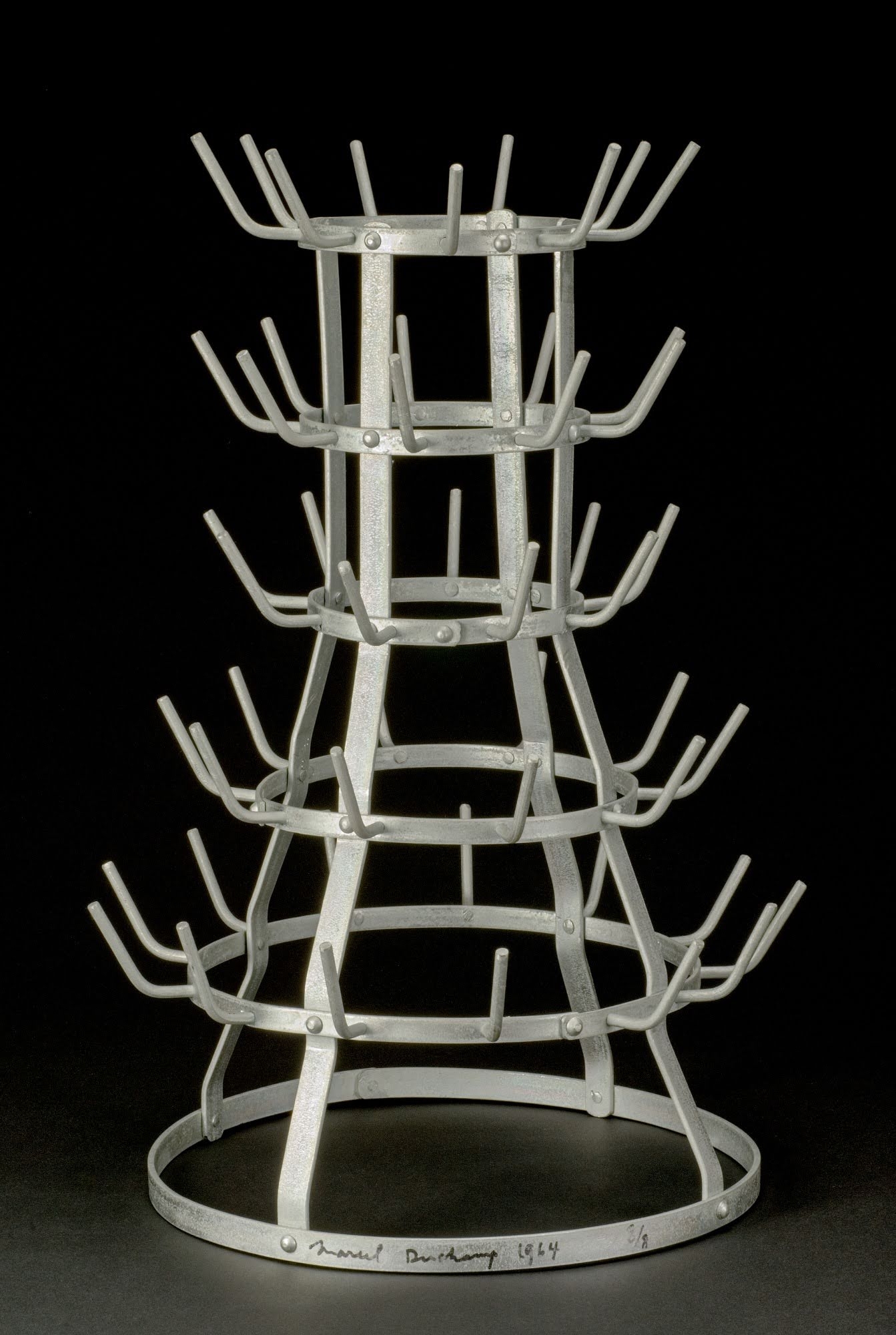
Marcel Duchamp (1887–1968), Bottle Dryer, 1964 edition (after 1914 original). Partial gift of Mrs. William H. Conroy, Eskenazi Museum of Art, Indiana University
On permanent display in Gallery 8 on the fourth floor are also 14 custom-made replicas from 1964, including Fountain and Bottle Rack. Comparing these, it is obvious Duchamp was not remotely bothered about achieving similarity in form. More important was the concept or symbolism of urinal for the urinal, bottle rack for the bottle rack, and subtle disparities were not an issue. The text “urinal” or “bottle rack” alone may have sufficed; a revolutionary idea that spawned the likes of Joseph Kosuth’s One and Three Chairs (1965) and Aida Makoto’s I-DE-A (2000): “Chair” being a chair; “Pretty Girl” a pretty girl.
The caption, however, notes, “these differences establish each object’s uniqueness, despite its status as a replica.”11 Grounded in the same fact that differences exist between the replicas, this draws exactly the opposite conclusion. The exhibition planners assert that the aim is to “present Duchamp’s body of work as a group of physical things, no matter how cerebral or conceptual the motives behind them may have been,”12 and to invite the public to “rediscover Duchamp by encountering the undeniably material presence of his work,”13 their reasoning being that “Only by bringing together these objects, these tangible manifestations of his mind, can we perceive just how revolutionary Duchamp’s approach to art making really was.”14 But is this really true?
It is, to be sure, a respectable-enough claim from a museum at the apex of the contemporary art system. After all, to be worth anything an artwork needs to be shown. But Duchamp is an unusual case. This is an artist who personally strove, successfully, to have most of the Louise and Walter Arensberg Collection, and part of the Katherine S. Dreier Collection, which together encompassed several of his key works, housed in none other than the Philadelphia Museum of Art and MoMA in New York.15 Readymades were a solution, an answer to the vital question Duchamp posed for himself: “Can one create works that are not ‘works of art’?” And whether original or replica, the readymades are not works of “art.” Duchamp endeavored to turn the art museum—which exists for the collection, preservation and display of artworks—into an (art) museum that is not about “art.” These collections including his own readymades were Trojan horses, dispatched to infiltrate the two museums.
The trio of curators on this occasion are all Duchamp specialists, and thus all too aware that readymades are not art. At the same time, they are responsible for exhibitions at two museums that do much to propel the system, and so cannot openly say this. The line “no matter how cerebral or conceptual the motives behind them may have been” indicates the tricky double bind in which they find themselves. Duchamp tried to destabilize, at the most fundamental level, the definition not only of art but of the art museum. They may know of the soldiers hiding in its belly, but the wooden horse is already inside the city walls.
I have written this review, if you can call it that, without seeing the MoMA exhibition in person. An unprecedentedly weak yen and resentment at the very existence of the 47th President of the United States aka TACO Man are my main reasons for not going, and will likely also prevent me from traveling to the PMA exhibition opening in October.16 But if you have never seen The Large Glass or Étant donnés, I recommend you take the opportunity. As unmistakably “works of art” these two are very much worth viewing first-hand.
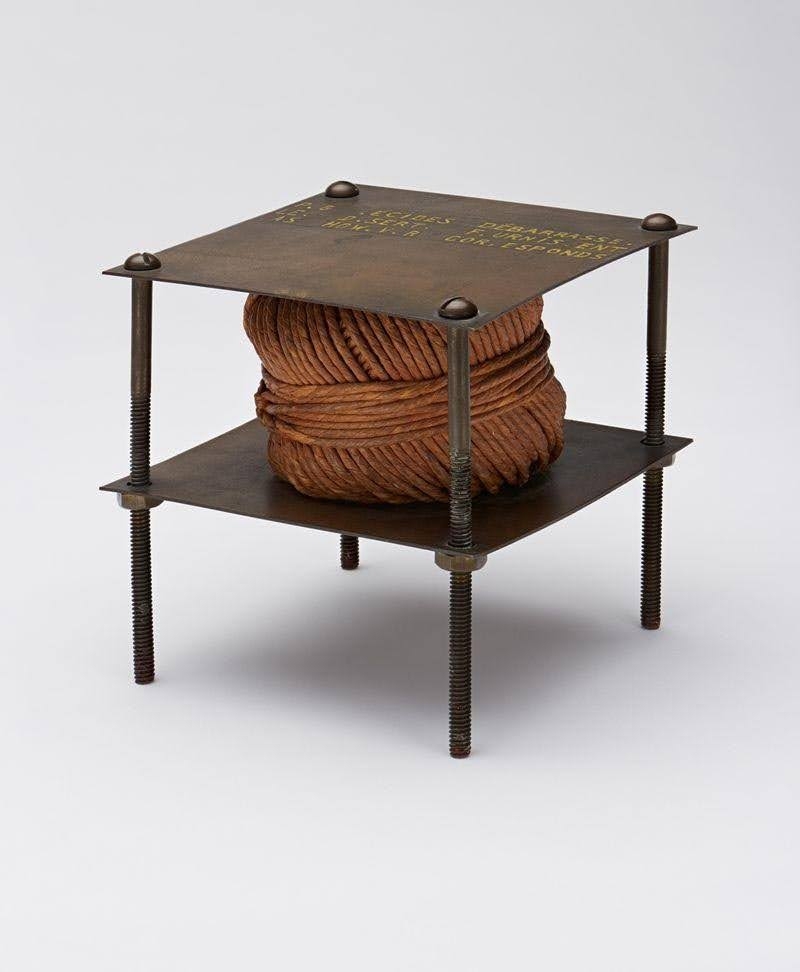
Marcel Duchamp, With Hidden Noise, 1916. Ball of twine between two brass plates, joined by four long screws. Philadelphia Museum of Art: The Louise and Walter Arensberg Collection, 1950, 1950-134-71.
© Association Marcel Duchamp/ADAGP, Paris/Artists Rights Society (ARS), New York 2026
The PMA also has the originals of Comb (1916), Hidden Noise (ditto), 50cc of Paris Air (1919), and Why Not Sneeze, Rose Sélavy? (1921), all exceptional among the readymades as approaching the status of “works of art.” New interpretations of the two signature works, and the true concepts of these four that have previously defied decoding, are presented in my book “Duchamp Thinking” due for release by Seigensha Art Publishing this autumn. At the risk of turning this into a promotional piece, I encourage you to peruse it before making the pilgrimage to Philadelphia.
1. The Duchamp catalogue raisonné compiled by Arturo Schwarz contains 663 works, while the Pablo Picasso catalogue raisonné compiled by Christian Zervos, for example, contains some 16,000 drawings and paintings alone, and over 20,000 items including sculptures, stage designs and costumes. Picasso’s lifetime output, including prints, is widely cited at roughly 150,000 works.
2. The Large Glass sustained cracks in the glass during transport, which the artist repaired himself, rendering it a work that could not be moved off-site. Étant donnés is a site-specific installation and likewise immovable.
3. Marcel Duchamp, Entretiens avec Pierre Cabanne (Sables/Allia, 2014), 47.
4. The MoMA exhibition was held from April 12 through August 22, 2026.
5. Marcel Duchamp, ed. Matthew Affron, Michelle Kuo, and Ann Temkin (Museum of Modern Art, New York / Philadelphia Museum of Art, 2026), 11.
6. April 2–October 3, 2022.
Exhibition dates per the Kulturstiftung der Länder website.
7. Elena Filipovic, The Apparently Marginal Activities of Marcel Duchamp (MIT Press, 2016).
8. Marcel Duchamp, 10.
9. Photographed by Alfred Stieglitz. It also appears in photographs taken at Duchamp’s studio-residence by Henri-Pierre Roché and others.
10. Several pieces from the “Box in a Valise” series containing miniatures are also on display, but not considered here.
11. Marcel Duchamp, 242.
12. Marcel Duchamp, 11.
13. Marcel Duchamp, 11.
14. Marcel Duchamp, 11.
15. For a detailed discussion see, Affron, Kuo, Temkin, “Duchamp and the Museum,” in Marcel Duchamp, 287–317.
16. The PMA exhibition will run from October 10, 2026 through January 31, 2027.
https://www.philamuseum.org/exhibitions/marcel-duchamp
About this series
In “Out of Kyoto,” writer and arts producer Ozaki Tetsuya takes up topics in art and culture. Drawing on history, the series explores the state of expression in the present day.
・Read all articles in this series here
Author profile
Ozaki Tetsuya
Writer / arts producer. Launched the culture webzine REALTOKYO in 2000 and the contemporary art magazine ART iT in 2003, and served as executive producer of performing arts for the Aichi Triennale 2013. He was publisher and editor-in-chief of the culture webzine REALKYOTO from September 2012 to December 2020, and editor-in-chief of its successor REALKYOTO FORUM from February 2021 to March 2025. His edited