
Differences: Shedding light on other cartographies in Korea
004 Gwangju, where history is still in motion 1
By Konno Yuki
- SHARE


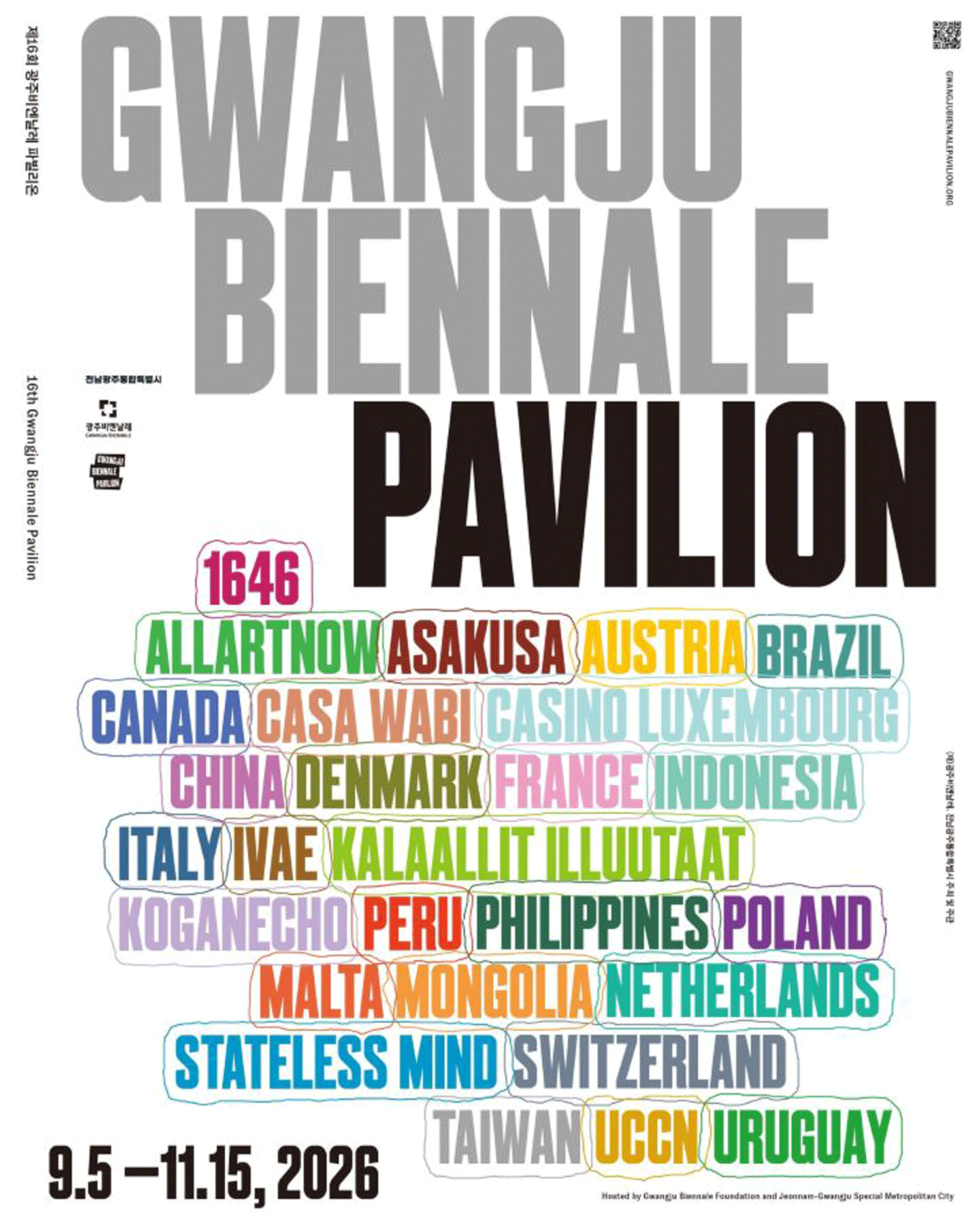
出典:https://www.gwangjubiennale.org/gb/exhibition/pavilion.do
1. Pavilion Project and name change
Immediately prior to opening of the 16th Gwangju Biennale “You Must Change Your Life” (Director: Ho Tzu Nyen) a problem occurred involving a name change at the Pavilion Project. The Pavilion Project is an exhibition separate from the main Biennale venue, staged since 2018 in art spaces and cultural institutions around the city of Gwangju. The Japanese contribution to the Project this year is courtesy of the ASAKUSA project space, and Koganecho. The issue in question arose with the Taiwanese contingent. Initially it was announced that participation would be under the name Taiwan Pavilion, however the listing on the official Biennale poster was NTMoFA (National Taiwan Museum of Fine Arts). The Pavilion Project has two categories for participation: national and institutional; this also applies to the aforementioned Japanese groups. After the curator and artists of the Taiwanese pavilion set out their views on August 15, in an open letter titled “A Pavilion Under Censorship,” the Biennale issued a statement on August 19 indicating that “NTMoFA” was adopted in line with the name of the organizing institution provided in the initial Pavilion Project application.1
Questions were raised around the Gwangju Biennale response to the issue, prominently by the “girlsbookshop,”2 and also by figures on the local art scene. They were joined by people from across the Korean cultural sector—starting with the group Artists’ Solidarity Against Censorship, which had also slammed censorship by SeMA (the Seoul Museum of Art) of a critique of one of its shows3—contending that the name change for the Taiwanese pavilion constituted “institutional censorship.” In response, on August 25 the Gwangju Biennale agreed to change the name to “Taiwan Pavilion.” (Which however then led to withdrawal of the Chinese pavilion.4) This is not a new problem: the Biennale dealt with the matter similarly for the 2024 Pavilion Project. On that occasion the Israeli pavilion, participating under CDA Holon,5 had changed its name following an order for provisional measures (order to halt the Rafah offensive) issued by the International Court of Justice and International Criminal Court in May 2024. But surely announcing participation in an art exhibition amid questions around your war culpability is a form of “artwashing”?6
2. Gwangju and the pro-democracy movement
It is often stated that such disputes are antithetical to the democratic spirit of Gwangju. Meaning what exactly?
Gwangju is in fact a symbolic location in the history of South Korea’s pro-democracy movement, a fact now more widely recognized in Japan thanks to Jang Hoon’s film A Taxi Driver. The pro-democracy campaign began to gain momentum in 1972 following the adoption of Park Chung Hee’s “Yushin Constitution” introducing laws that included election of the president not by the people’s votes, but those of the National Conference for Unification. The movement grew further with Park Chung Hee’s assassination on October 26 1979. However Chun Doo-hwan, then head of the country’s security command, joined by the Hanahoe secret society of elite army officers, seized power that same year in a coup (the 12·12 Military Insurrection). The following year, on May 17, 1980, the entire country was placed under martial law. Suppression of the pro-democracy movement was ramped up, including a ban on political activities, restrictions on speech, and university closures. Emerging opposition centered around students at Chonnam National University in Gwangju. On May 22 citizens entered negotiations to achieve a withdrawal of the troops mobilized to enforce martial law, and prevent further hostilities. The governing junta however refused to accept defeat, and following an initial withdrawal of weapons, from the night of the 26th to early dawn on the 27th tanks were sent in again (Sang-Mu Loyalty Operation), resulting in a large number of civilian casualties.
Thus in this place that sacrificed so much during the fight for democracy, institutional censorship or control of any sort, even on the part of a museum or art-related organization, is anathema. The city still bears vivid scars from the shooting, at Jeonil Building 245, so named because its address (Geumnam-ro 245) happens to coincide with the number of bullet holes left by helicopters mobilized to put down the protests.7 Interestingly, Jeonil Building 245 does not only document the past, it relays it in accordance with the most up-to-date developments in media technologies. For example, VR is used to convey the terror of being shot at by a helicopter, and the topic of fake news fact-checking is raised. Thus the means of communication is modified as the museum explores how to pass contemporary records to future generations. Although some distance from the main Gwangju Biennale venue, it is well worth a visit if time permits.
Opposite Jeonil Building 245 remains part of the former Jeonnam provincial government building. Records and photographs from the era can also be found in this building viewed as scene of the final bloody battle of the campaign for South Korean democracy. Behind it sits the Asian Culture Center. Although the provincial government building was given cultural heritage status in 2002, from around 2005 it was rocked by problems with its deteriorating condition, and planned redevelopment:8 demolition of the main building was mooted as part of this redevelopment plan, a campaign had been launched to make Gwangju Korea’s cultural capital (enacted as the “Special Act on the Development of Asian Cultural Hub City”), and moves to commence construction of the Culture Center were underway. The Asian Culture Center did eventually open, in 2015, and in addition to exhibitions is used as a venue for the Gwangju Biennale.
Thus Gwangju’s past is offered up as a message for Asia’s future. The art that has been a dynamic part of this can doubtless be discussed specifically in terms of the actions of the world-renowned Gwangju Biennale, and the “Minjung Art” that linked art and the pro-democracy campaign. (Continued in part 2)
1. See
https://gwangjubiennale.org/en/Board/12158/detailView.do
2. A humanities, social science, and arts bookstore located behind Gwangju Theater, run by a local theater director and independent cultural planner.
3. For further information see,
https://k-artnow.com/posts.php?&co_id=1750952068
4. Driven by Beijing’s “One-China Principle,” the Chinese Ambassador to South Korea visited the Mayor of Gwangju on August 27 to object to the “Taiwan Pavilion” name. On August 28–29, the China Cultural Center, operator of the China Pavilion, sent an official letter demanding the name change be reversed. “Daemangwan’ ssuja Jung banbal… Yang-an gwangye-ro momsal an-neun Gwangju Biennal-le” [“Taiwan Pavilion” backlashes from China… Gwangju Biennale plagued by cross-strait relations], Chosun Ilbo, September 1, 2026.
https://www.chosun.com/culture-life/culture_general/2026/09/01/SITZWX7YVVDWVEMTT65R5G7GYE/
5. The Center for Digital Art, based in Holon, Israel.
6. Of course, this issue is not unique to CDA Holon. It applies equally to projects within South Korea, such as the protests surrounding the opening of Centre Pompidou Hanwha on June 4, 2026, driven by opposition to the Hanwha Group, a South Korean explosives and defense conglomerate with close ties to the Israeli defense industry.
7. The bullet marks were identified during investigations conducted between 2016 and 2017, making the count a coincidence, however, an additional 25 marks were discovered in 2019. “Soreum dodneun u-yeon, Gwangju Geumnam-ro 245-beonji-e bak-hin tanhwan 245-gae” [Goosebump-inducing coincidence: 245 bullets embedded at 245 Geumnam-ro, Gwangju], JoongAng Ilbo, May 18, 2021.
https://www.joongang.co.kr/article/24060386
8. “5.18 Minjuhwa seongji yet Jeonnam docheong-eul jikyeojuseyo” [Save the former Jeonnam provincial government building, sacred ground of the May 18 Democratization Movement], JoongAng Ilbo, July 20, 2008.
https://www.joongang.co.kr/article/3231491
About this series
“Differences: Shedding Light on Other Cartographies in Korea” is a series by art critic Konno Yuki, who is based between South Korea and Japan. Deliberately shifting focus away from Seoul, the country’s cultural and artistic hub, the series looks anew at other regions, tracing a line through alternative activities and art discussed within local contexts to bring a new outline of Korea’s art scene into view.
Author profile
Konno Yuki
Art critic based mainly in South Korea. Curated exhibitions including “After 10.12” (Audio Visual Pavilion, 2018) and “Korean Painting and Eastern Painting” (gallery TOWED, FINCH ARTS, Jungganjijeom II, 2022). In charge of Korea coverage for Padograph (https://padograph.com/ja), a portal site introducing exhibition and event information in Japan and Korea. Runner-up, GRAVITY EFFECT 2019 art criticism competition.